
NHL Penalties: What the Minutes Mean—and When a Goal Ends Them
Understand NHL penalty types, two- and five-minute calls, double minors, misconducts, delayed calls and why PIM is not time spent shorthanded.
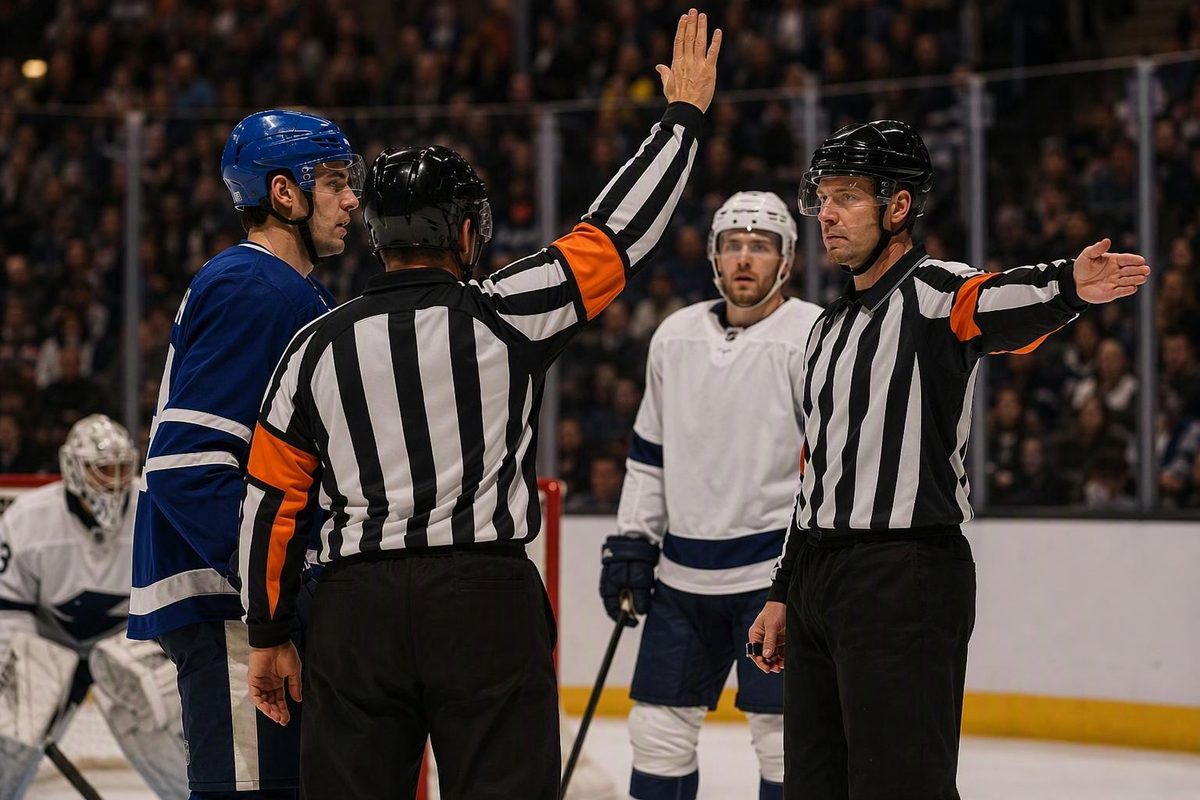
An NHL minor penalty lasts two minutes, a double minor four and a major five. A misconduct removes a skater for ten minutes but does not, by itself, reduce his team’s on-ice strength. The key distinction is between the punishment assigned to a player and the time his team must play shorthanded. The opponent has a power play when penalties give it a numerical advantage in skaters.
Here is how those penalties work under the 2026–27 NHL Official Rules.
NHL penalty types and durations
The table assumes regulation play, with no other penalties in effect. Durations are playing time, not elapsed time watching the game.
| Penalty type | Duration or removal | Effect on the team |
|---|---|---|
| Minor | 2 minutes | Plays one skater short; an opposing power-play goal can end the penalty early |
| Bench minor | 2 minutes, served by a designated skater | Same manpower effect as a minor, but assessed against the team |
| Double minor | 4 minutes, in two successive 2-minute parts | Plays one skater short; a power-play goal ends the part currently being served |
| Major | 5 minutes | Plays one skater short for the full penalty, regardless of opposing goals |
| Misconduct | 10 minutes; skater waits for a stoppage after expiry | An immediate replacement is allowed; no manpower reduction by itself |
| Game misconduct | Player removed for the rest of the game | An immediate replacement is allowed unless another penalty requires the team to play short |
| Match | Player removed for the rest of the game, plus a 5-minute team penalty | A teammate serves the time; the offender is suspended from further competition until the Commissioner rules |
These distinctions come from Rules 16–23. A game misconduct adds ten minutes to the player’s statistical record; it does not mean a ten-minute power play. A match penalty records fifteen minutes: five for the time penalty and ten for removal.
Goalies do not sit in the box for minor, major or misconduct penalties. A teammate serves the penalty instead; a goalie receiving a game misconduct or match penalty must leave the game (Rule 27).
What the penalty names mean
The infraction describes what happened; the penalty type describes the punishment. “Cross-checking” is an infraction, for example, and can result in a minor or a more severe penalty.
Calls you will encounter include:
- Holding: using the hands, arms or legs to restrain an opponent.
- Hooking: using the stick to restrain or impede an opponent.
- Tripping: placing the stick or part of the body so an opponent trips or falls, subject to the rule’s accidental-trip exceptions.
- Interference: illegally impeding or checking an opponent who does not possess the puck. Established body position and contact immediately after loss of puck possession matter.
- Cross-checking: forcefully checking an opponent with the stick shaft between the hands.
- Slashing: a forceful stick chop that is not an attempt to play the puck; contact is not always required.
These are summarized from Rules 54–61, rather than a ranking of which calls occur most often.
High-sticking is another important distinction. Illegal stick contact above an opponent’s shoulders normally draws a minor; Rule 60.1 specifies that the shoulders must be at waist level or higher. Injury-producing contact to the neck, face or head above the opponent’s waist draws a double minor—“drawing blood or otherwise,” so visible blood is not the only criterion. Normal shooting windup or follow-through has an accidental-contact exception (Rule 60).
Fighting carries a five-minute major. Additional penalties can apply to an instigator or aggressor. If each team receives only a matching fighting major, substitutions are allowed, so the fight does not itself create a power play (Rules 19 and 46).
When does a goal end a penalty?
For a minor to end early, the team scored against must be shorthanded and serving an eligible minor on the penalty clock. With multiple eligible minors, the one with the least time remaining ends. A shorthanded goal does not release the scorer’s penalized teammate, and a penalty-shot goal does not end an existing penalty. These conditions are set out in Rule 16.2.
A double minor is two penalties in sequence, not one indivisible four-minute penalty. With no other penalties involved:
- A power-play goal 40 seconds into a double minor ends the first part; the second two-minute part starts immediately.
- If no earlier goal has shortened the penalty, a power-play goal after 2:40 ends the second part, releasing the player.
A major remains in effect for all five minutes. The opponent can score more than once without ending it. See Rule 20.2 and Table 12.
Why the scoreboard shows 5-on-4, 4-on-4 or 4-on-3
In regulation, one unopposed time penalty normally turns 5-on-5 into 5-on-4; two can create 5-on-3. These counts refer to skaters, excluding goalies. A team cannot be reduced below three skaters by penalties, so a third player’s penalty may have to wait before its clock starts.
Matching penalties do not always preserve 5-on-5. One minor to each team at the same stoppage, with no other penalties on the clocks, produces 4-on-4 in regulation. Matching majors allow replacements.
In regular-season 3-on-3 overtime, an unopposed penalty normally creates 4-on-3, not 3-on-2: the non-offending team adds a skater. A two-skater advantage produces 5-on-3. These situations are governed by Rules 19, 26 and 84.3. For the wider lineup distinction, see how many players are on the ice and on a hockey team.
What a delayed penalty means
When the team committing an infraction does not control the puck, the referee raises an arm and delays the whistle until that team gains control.
If the non-offending team scores during a delayed minor call at otherwise even strength, that minor is not imposed. For a delayed double minor in the same situation, one two-minute part is washed out and the other is served. A major or match penalty still applies.
If the offending team is already shorthanded because of a minor on the clock, a goal during a further delayed minor call terminates the eligible existing minor while the newly signaled penalty is assessed. These distinctions are covered by Rules 15 and 18.2.
A penalty shot is a separate remedy for specified infractions—not simply another duration of penalty-box time.
Reading penalties in a stat line
PIM means penalty minutes assessed, not minutes spent shorthanded. A player receiving a minor plus a misconduct has 12 PIM, but the misconduct adds no separate manpower disadvantage. Matching fighting majors also contribute PIM without creating an advantage for either team.
For performance analysis, separate the penalty total from the manpower situation and its duration. The PIM statistics guide explains why those numbers should not be treated as interchangeable.