
Best Shooters of All Time: Ovechkin, Bossy, Hull and the Numbers Behind Them
Compare the NHL’s greatest shooters by scoring output, release and measured shot speed—and see why the hardest shot is not automatically the best.
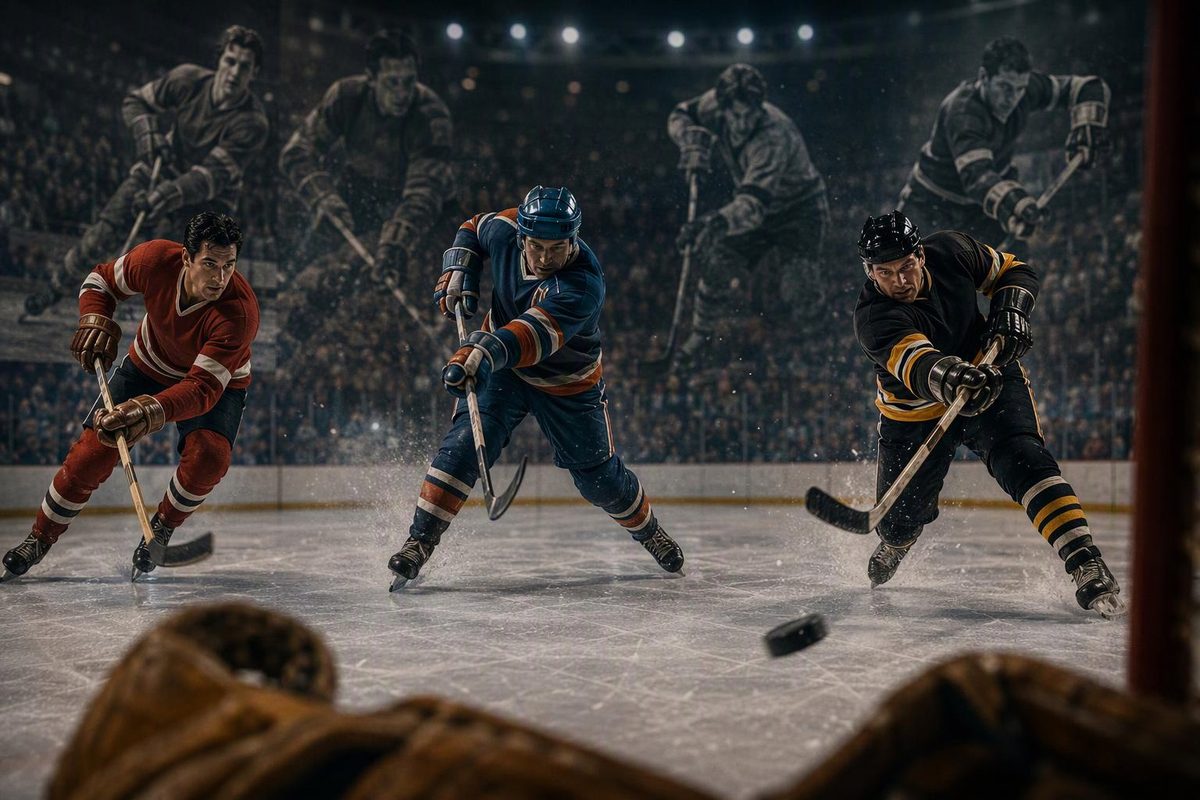
Alex Ovechkin is our strongest overall pick for the NHL’s best shooter of all time. His career goal record supplies the clearest outcome-based case. Mike Bossy and Brett Hull belong in the discussion for quick-release finishing, Joe Sakic for his wrist shot, and Al MacInnis and Zdeno Chara for slapshot excellence.
That is an editorial judgment, not a measured all-time shooting ranking. Goals, release time and puck velocity answer different questions—and hockey does not have comparable tracking data spanning every generation.
The shortlist, with the evidence defined
This selection weighs sustained scoring, exceptional scoring peaks and documented shooting strengths. It is not simply the career goals leaderboard, nor an ordered ranking from first to eighth.
All goal figures below are NHL regular-season totals. Ovechkin’s active career total was checked October 24, 2026; the other career totals are final.
| Shooter | Quantitative evidence | What makes the case distinctive |
|---|---|---|
| Alex Ovechkin | 930 career goals, the NHL record | The strongest career-output case |
| Mike Bossy | 573 goals in 752 games: 0.762 goals per game, calculated | Exceptional scoring frequency across his career |
| Brett Hull | 741 career goals; 86 in 1990–91 | A remarkable peak backed by sustained finishing |
| Mario Lemieux | 690 goals in 915 games: 0.754 goals per game, calculated | A career scoring rate close to Bossy’s |
| Wayne Gretzky | 894 career goals; 92 in 1981–82 | An extraordinary single-season scoring benchmark |
| Joe Sakic | 625 career goals | A renowned wrist shot with substantial scoring output |
| Al MacInnis | 340 career goals; seven NHL Hardest Shot wins | Slapshot excellence supported by repeated skills-event results |
| Zdeno Chara | 108.8 mph at the 2012 NHL All-Star Skills competition | A directly measured peak-velocity achievement |
The mixed metrics are deliberate: Chara’s miles per hour cannot be converted into Bossy’s goals per game. Each supports a different part of the shooting argument.
Why Ovechkin gets the overall nod
Ovechkin passed Gretzky with goal No. 895 on April 6, 2025. The record-breaker was a wrist shot from the left circle on the power play—not a slapshot one-timer. At that milestone, NHL.com’s charting placed 393 of his 895 goals, or 43.9%, in the left circle or above it. That is a location count, not a shot-type breakdown. The NHL’s game report documents both the goal and the charting.
The distinction matters. Reducing Ovechkin to one familiar shooting motion misses what the record captures: repeated scoring success over a long career. It does not prove he had the fastest release or hardest shot ever, but it makes him the most defensible overall choice when successful finishing carries the greatest weight.
Release and placement: Bossy, Hull and Sakic
Bossy’s NHL biography emphasizes his ability to find unguarded space and propel the puck goalward almost immediately after receiving a pass. That is historical description, not a release-time measurement in milliseconds. His scoring rate provides a separate numerical reason to take that reputation seriously. NHL player biography.
Hull’s case is similarly about more than power. The NHL’s retrospective identifies the quickness of his release as a greater problem for goalies than his shot velocity, while describing his ability to find open ice and shoot accurately from different body positions. NHL retrospective.
Sakic is a compelling wrist-shot selection, but calling his wrister measurably the best ever would overstate the evidence. His NHL profile documents its reputation and his sustained shooting practice; it does not supply a standardized cross-era test. NHL retrospective.
Why the hardest shot does not settle “best”
Chara’s 108.8 mph shot was a skills-competition attempt into an open net. MacInnis’s seven Hardest Shot victories demonstrate repeated success in that format. The NHL’s Hardest Shot retrospective documents both. Neither result measures finishing against a positioned goalie, through traffic or under defensive pressure.
Modern NHL EDGE data adds in-game shot speed and location, but its public historical coverage begins in 2021–22. The system uses arena cameras and infrared emitters in pucks and player sweaters; it cannot retrospectively measure prime Bossy, Hull or Sakic. NHL EDGE launch explanation.
Career goals also reflect opportunity and longevity. Goals per game reduce the longevity effect, but do not adjust for ice time, teammates or scoring environment. Shooting percentage—goals divided by shots on goal, multiplied by 100—adds another view. It excludes missed and blocked attempts, as the NHL statistics glossary explains. That makes it different from an all-attempt accuracy measure; it also depends on the chances a player takes.
For a speed-record comparison, see the fastest ice hockey shot and why the records differ. For evaluating a shooter, keep the questions separate: how fast the puck travels, how quickly it leaves the stick, and how often the attempt becomes a goal.