
NHL All-Time Hits Leaders—and What the Record Counts
Cal Clutterbuck leads the NHL’s career hits record with 4,029. See the top 10, the 2005–06 cutoff and why hit totals don’t measure impact.
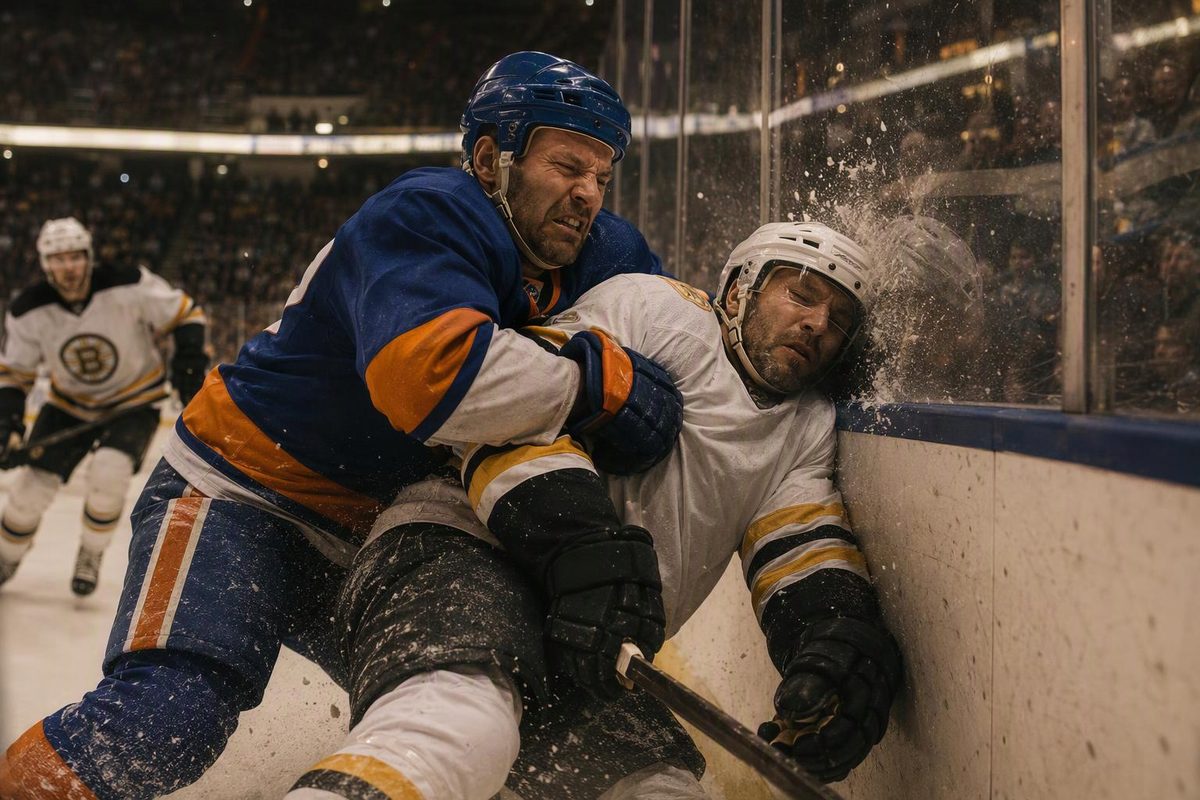
Cal Clutterbuck leads the NHL’s official career hits leaderboard with 4,029, ahead of Matt Martin, Alex Ovechkin and Luke Schenn. These are regular-season totals in the NHL record book’s “Real Time (Since 2005–06)” category, not a complete count of body checks throughout NHL history. Source: NHL Records.
The top 10 NHL career hits leaders
The following is the NHL Records leaderboard as of October 14, 2026. Playoff hits are excluded; totals for players still competing can change.
| Rank | Player | Recorded hits |
|---|---|---|
| 1 | Cal Clutterbuck | 4,029 |
| 2 | Matt Martin | 3,936 |
| 3 | Alex Ovechkin | 3,887 |
| 4 | Luke Schenn | 3,829 |
| 5 | Dustin Brown | 3,632 |
| 6 | Milan Lucic | 3,275 |
| 7 | Radko Gudas | 3,235 |
| 8 | Ryan Reaves | 3,225 |
| 9 | Brooks Orpik | 2,946 |
| 10 | Nick Foligno | 2,885 |
Source for all rankings and totals: NHL’s Most Hits, Career record table.
Clutterbuck retired on April 23, 2025, after 1,064 regular-season games for Minnesota and the New York Islanders, finishing with 4,029 hits. His retirement and total are confirmed by the Islanders’ announcement and his NHL biography. In this snapshot, Martin trails him by 93 hits, Ovechkin by 142, and Schenn by 200, calculated from the leaderboard above.
What counts as a hit—and how far back does the record go?
The NHL defines hits as the number of body checks a player delivers against the opposing team’s puck carrier. It is an event count: one credited check adds one hit. It does not measure collision force, impact speed or how much the check helped the defending team. Source: NHL statistics glossary.
The historical boundary matters. The official career record used here starts in 2005–06. The NHL glossary separately says hits data is available since 1997–98. Those statements describe different coverage: availability of earlier statistics is not the same as the date range used by this particular record table. When comparing lists, check their start season rather than assuming every “all-time” total uses the same window. Sources: NHL Records and NHL glossary.
Consequently, this leaderboard cannot settle who delivered the most checks across every era. Players whose careers began before the record window have only part of their careers represented, while earlier generations cannot be compared on this basis.
Career totals are not hitting rates or defensive ratings
A cumulative record rewards both frequent hitting and longevity. Using hits divided by games played in the official table:
- Clutterbuck: 4,029 ÷ 1,064 = 3.79 hits per game.
- Martin: 3,936 ÷ 987 = 3.99 hits per game.
- Ovechkin: 3,887 ÷ 1,579 = 2.46 hits per game.
Martin has the higher rate among these three despite ranking second in total hits. Hits per game still does not adjust for ice time; hits per 60 minutes uses playing time as the denominator instead. Neither rate measures the outcome of a check. Data: NHL Records; rate definitions: NHL glossary.
Recording consistency also matters. An original study of five-on-five, non-empty-net regular-season play from 2007–08 through 2012–13 found rink-dependent differences in recorded events, including hits, after accounting for team and game factors. That is evidence of historical scorer effects—not a basis for applying those old adjustments to today’s leaderboard. Read the study.
Use the career list to identify leaders in recorded checking volume. To evaluate defensive value, also ask whether a check disrupted possession, enabled a recovery or left the player out of position. The same distinction between event volume and effectiveness applies when interpreting blocked-shot totals.