
How Long You Have Between Hockey Periods
Compare NHL regulation breaks, regular-season overtime, playoff overtime and IIHF intermissions, plus when the clock starts and why youth schedules vary.
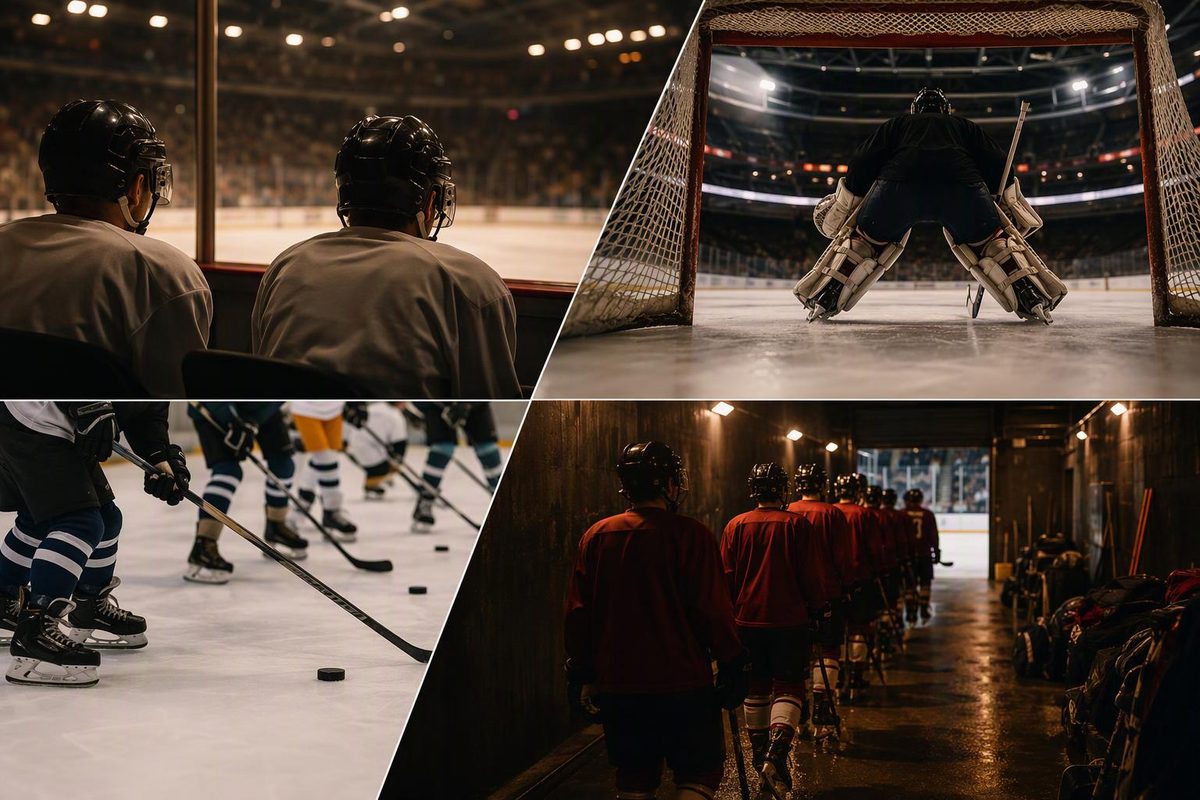
NHL hockey intermissions last 18 minutes between regulation periods, unless the league designates a different duration. There are two scheduled breaks: one after the first period and one after the second, adding 36 minutes of intermission time to regulation. Rule 77.2 of the 2026–27 NHL rulebook sets that standard. Before overtime, the break depends on whether the game is regular season or playoffs; outside the NHL, 18 minutes is not a universal rule.
Choose the game situation to see the applicable break and its timing caveat.
Find Your Intermission Rule
NHL regulation standard unless the league designates another duration. The countdown starts when the last official leaves the ice.
| Situation | Break | Details |
|---|---|---|
| NHL regulation | 18 minutes | RuleRule 77.2: unless the league designates another duration. Rule 34.2: countdown starts when the last official leaves the ice; unusual delays allow discretion. |
| NHL regular-season overtime | ~2 minutes | RuleRule 84.1: approximate turnaround after regulation and ice shoveling, not a fixed intermission countdown. Teams do not return to their dressing rooms. |
| NHL first playoff overtime | 15 minutes | RuleRule 84.5: the break before the first overtime period, followed by a 20-minute sudden-death period. |
| IIHF regulation | 15 minutes | RuleRule 77.2: unless the IIHF designates another duration. This entry does not specify an overtime break. |
Sources: 2026–27 NHL rules and 2026–27 IIHF rules. ~ means approximate; youth-specific durations are not supplied.
Intermission Length Depends On The Game Situation
| Game situation | Break length | Rule qualification |
|---|---|---|
| NHL, between regulation periods | 18 minutes | Unless the league designates another duration |
| NHL regular season, before overtime | Approximately 2 minutes | No intermission countdown; play starts after ice shoveling |
| NHL playoffs, before first overtime | 15 minutes | Followed by a 20-minute sudden-death period |
| IIHF, between regulation periods | 15 minutes | Unless the IIHF designates another duration |
Sources: NHL Rules 77.2, 84.1 and 84.5 in the 2026–27 official rules; IIHF Rule 77.2 in the 2026–27 official rulebook.
The distinction is not simply NHL versus international hockey. Within the NHL, the same game can have a regulation intermission and a different transition into overtime. The regular-season overtime figure is also approximate, whereas the regulation rule specifies an intermission duration.
Use the row for the break you are actually timing. If the second period has ended in an NHL game, the regulation standard applies. If the third period has ended with a tie, the relevant question becomes regular season versus playoffs. Carrying the regulation number into that overtime transition gives the wrong answer in either case.
The two 15-minute entries should not be treated as interchangeable rules. One concerns the first overtime break in the NHL playoffs; the other concerns breaks between regulation periods under IIHF rules. Their durations match, but their scope does not.
The NHL Countdown Starts After The Last Official Leaves
The NHL’s 18-minute countdown starts when the last official leaves the ice, not necessarily at the instant the period-ending horn sounds. The arena’s electronic clock displays the remaining intermission time. Rule 34.2 also allows discretion in starting the countdown when unusual delays occur, including ice, resurfacing or building problems. NHL Rules 34.2 and 77.2
That creates two different measurements: the official intermission countdown and the elapsed time from the horn to the next puck drop. The rule establishes the former. It does not guarantee that the latter is exactly 18 minutes.
For someone watching in the arena, the displayed countdown is therefore more useful than a timer started at the horn. Your timer and the official clock need not begin together. An unusual delay can also make a horn-based estimate less useful without changing the standard regulation intermission duration.
If you step away from your seat or the broadcast, return before the displayed countdown expires. Treat 18 minutes as the rule’s scheduled break, rather than as a promise that you can leave at the horn and arrive exactly 18 minutes later without missing play.
Two Regulation Intermissions Add 36 Minutes
An NHL regulation game contains three 20-minute periods of actual play. Its two standard intermissions contribute another 36 minutes. The basic calculation is 60 minutes of playing time + 36 minutes of intermissions = 96 minutes.
That calculation describes a playing-time-and-intermission subtotal, not the game’s total elapsed length. It excludes stoppages within periods. The game clock stops for whistles and goals, while intermissions add time between periods. NHL Rules 34.1 and 77.1
The distinction matters when planning around a game. Knowing the scheduled breaks tells you how much intermission time regulation contains. It does not tell you when the final horn will sound, because the supplied rules do not establish a fixed allowance for all the stopped-clock time within those periods.
Nor does the subtotal resolve the difference between the official intermission countdown and horn-to-puck elapsed time. It uses the prescribed intermission durations, not a measured total for a particular game.
Do not add a third 18-minute intermission merely because regulation has three periods. The standard breaks are after the first and second periods. After the third, regulation has ended; any transition to overtime follows the applicable overtime rule instead. For the broader scheduling distinction, see regulation time versus real game time.
Regular-Season Overtime Has An Approximately Two-Minute Turnaround
A tied NHL regular-season game does not receive another 18-minute break after the third period. Teams do not return to their dressing rooms while arena personnel shovel the ice. The rules expect overtime to begin approximately two minutes after regulation ends.
There is no intermission countdown put on the clock for this transition. The approximately two-minute figure is an expected turnaround, not a fixed countdown equivalent to the one used between regulation periods.
For a viewer, this is the break most easily misjudged by relying on the regulation standard. The first two intermissions may have allowed time to leave your seat; that experience does not establish how much time you have before regular-season overtime. Once a tied third period ends, the rules describe a much shorter transition.
For timing or data recording, label this interval as approximate. Reporting it as an exact two-minute intermission would remove a qualification that the rule itself includes. A measurement from a particular game might differ, but the supplied draft does not contain observed turnaround times or a league-wide average to compare against the rule.
The distinction also explains why the comparison tool shows this entry with an approximation mark. It is selecting the relevant rule, not forecasting the next puck drop to the second.
The First NHL Playoff Overtime Break Is 15 Minutes
Before the first overtime period in an NHL playoff game, the intermission is 15 minutes. That break is followed by a 20-minute sudden-death period, under Rule 84.5.
The 15-minute intermission and the 20-minute period measure different parts of the sequence. The first is a break between play; the second is the scheduled overtime playing period. Neither number should replace the other when answering how long spectators have before play resumes.
This playoff transition is also different from both NHL regulation intermissions and the regular-season overtime turnaround. A tied score after regulation is not enough information to choose a break duration: the competition stage determines which NHL overtime rule applies.
The comparison here specifically identifies the break before the first overtime period. It should not be read as a separately verified schedule for every later overtime interval. The supplied draft does not provide that fuller sequence, so the tool does not attempt to calculate the elapsed length of a multi-overtime playoff game.
For the same reason, a 20-minute sudden-death period is not a promise that the game will continue for that entire playing-time allowance. Keep the intermission duration separate from the overtime format when describing the schedule.
IIHF Regulation Intermissions Use A 15-Minute Standard
Under IIHF Rule 77.2, intermissions between regulation periods last 15 minutes, unless the IIHF designates a different duration. That is the standard in the cited 2026–27 IIHF rulebook, rather than the NHL’s 18-minute regulation standard.
The exception belongs with the number. “IIHF intermissions are 15 minutes” is useful shorthand, but it is incomplete if it implies that the governing body cannot designate another duration. For a specific event, a designated exception would take precedence over the general figure shown here.
This source establishes the IIHF regulation rule. It does not establish a universal intermission time for every game played outside the NHL, every domestic league, or every youth competition. A game being played internationally is not, by itself, enough to identify which competition rules govern its schedule.
The table also does not supply an IIHF overtime-break duration. Selecting the IIHF option in the tool answers the between-regulation-periods question only. If you need an overtime transition for a particular IIHF event, the relevant event rules are needed; substituting the NHL overtime figures would mix rule systems.
Youth Hockey Requires The Age Group And Event Schedule
USA Hockey’s 2025–29 Rule 636(a) describes a maximum game format of three 20-minute periods with 15-minute intermissions that allow for resurfacing. That maximum format is not a timetable for every youth game.
A maximum tells you the scope of the described format; it does not prove that a particular age group or event uses all of it. Applying either the NHL’s 18-minute standard or USA Hockey’s maximum-format break to an unspecified youth game would therefore give the reader more certainty than these sources support.
The Tier 1 Hockey Federation’s gameday protocols illustrate the variation within one league. They list no in-game ice cut for 9U through 14U, but an ice cut after the second period for 15U, 16U and 18U.
Those protocols describe where an ice cut occurs. The supplied draft does not provide a break duration for each of those groups. No in-game ice cut should not be converted into “no break,” and an ice cut after the second period should not be converted into an assumed 15- or 18-minute intermission.
For players, coaches and parents, the actionable figure is the break specified for their age group and event. If that figure is absent from the available schedule, the duration remains unknown here. The professional-league comparison cannot fill that gap.
Use The Rule Duration Without Turning It Into A Forecast
For an NHL regulation break, the answer is 18 minutes on the official countdown, subject to a league-designated change. For the transition after a tied third period, use the overtime rule instead: approximately two minutes in the regular season, or 15 minutes before the first playoff overtime period.
For an IIHF regulation break, use the 15-minute standard with its designation exception. For a youth game, use the competition’s actual schedule rather than a professional benchmark or a maximum game format.
These figures answer how long the specified break is supposed to be. They do not supply a measured average for horn-to-puck time, a prediction of the final horn, or a complete timetable for every league. The supplied sources contain no observed intermission-time distribution or average total game duration.
That is why the tool returns a duration alongside its qualification rather than a clock-time promise. The format selects the rule; the arena countdown or event schedule tells you how to use it for the game in front of you.