
Kulyash's 110.3 mph Slapshot Is the Record That Holds Up
Guinness lists Denis Kulyash's 110.3 mph KHL slapshot as the hardest in any competition. See how Riazantsev, Frk and Chara compare and why the sources differ.
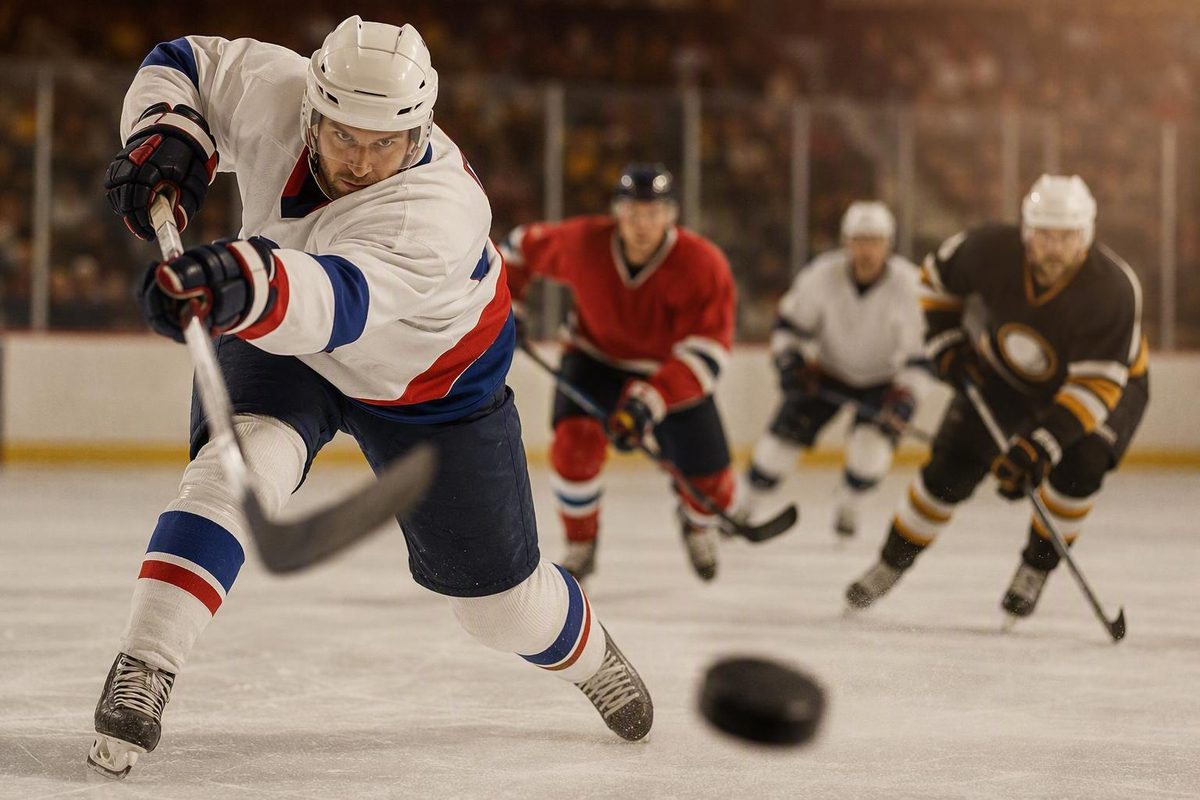
The fastest ice hockey shot with a record body behind it is Denis Kulyash’s 110.3 mph (177.5 km/h) slapshot. Guinness World Records lists it as the “hardest recorded ice hockey shot in any competition.” Kulyash, then with Avangard Omsk, hit it at the KHL All-Star skills competition in St. Petersburg on February 5, 2011. A higher number, 114.127 mph, is attributed to Alexander Riazantsev, but its only cited source is a tertiary summary that flags itself as under-cited, so the two claims are not equivalent. Guinness documents Kulyash’s result and the record’s stated scope.
Enter a shot speed to see where it ranks against the six documented marks; tap a column to sort, tap a row for the source.
Where Does a Shot Rank Against the Documented Marks?
| Player | mph▼ | Event | Evidence |
|---|---|---|---|
| A. Riazantsev | 114.1 | 2012 KHL, Riga | Tertiary, uncited |
| Reported 114.127 mph / 183.67 km/h, January 21, 2012. Only cited source is a collaborative encyclopedia page flagged as needing citations; no primary KHL or event record. Not equivalent to the Guinness listing. | |||
| D. Kulyash | 110.3 | 2011 KHL All-Star | Guinness listing |
| 110.3 mph / 177.5 km/h, KHL All-Star skills competition, St. Petersburg, February 5, 2011, for Avangard Omsk. Guinness: hardest recorded shot in any competition. | |||
| M. Frk | 109.2 | 2020 AHL All-Star | NHL.com report |
| 109.2 mph / 175.7 km/h, AHL All-Star Classic, Toyota Arena, Ontario, California, 2020. Exact date not given in the cited NHL account. AHL skills-event mark only. | |||
| Z. Chara | 108.8 | 2012 NHL Hardest Shot | NHL team history |
| 108.8 mph / ~175.1 km/h, NHL All-Star Skills Competition, Ottawa, January 29, 2012. NHL competition benchmark; Chara won the event five straight years, 2007 to 2012. | |||
| Z. Chara | 105.4 | 2009 NHL Hardest Shot | NHL team history |
| 105.4 mph, 2009 NHL Hardest Shot; beat Iafrate's 1993 mark by 0.2 mph. | |||
| A. Iafrate | 105.2 | 1993 NHL Hardest Shot | NHL team history |
| 105.2 mph, 1993 NHL Hardest Shot; the earliest mark in the cited NHL progression. | |||
Sources: Guinness World Records (Kulyash); NHL.com and Golden Knights competition history (Frk, Chara, Iafrate); Wikipedia "Slapshot" page (Riazantsev, flagged as needing citations). Events used different rules and radar setups; ranks are not a standardised comparison.
Kulyash Holds the Guinness-Listed Mark at 110.3 mph
The category wording matters. Guinness calls Kulyash’s attempt the hardest recorded shot in any competition. It is not a claim about every shot ever taken in every rink, and it is not a league-specific NHL or AHL skills-event benchmark.
That scope makes Kulyash the strongest answer when the question is “what is the recognised world record.” The Guinness entry names the player, team, speed, event, city and date. It does not say whether the category has been updated since 2011, and it does not address the higher figures reported elsewhere, so the mark should be described as the Guinness-listed record rather than an undisputed all-time maximum.
The Four Leading Claims Side by Side
The leading figures come from different competitions with different levels of documentation. Nothing in the sources shows these events used the same radar equipment, rules or measurement procedures.
| Player | Speed | Event | Evidence |
|---|---|---|---|
| Denis Kulyash | 110.3 mph / 177.5 km/h | KHL All-Star skills, St. Petersburg, Feb 5, 2011 | Guinness listing |
| Alexander Riazantsev | 114.127 mph / 183.67 km/h (reported) | KHL event, Riga, Jan 21, 2012 | Tertiary summary, needs citations |
| Martin Frk | 109.2 mph / 175.7 km/h | AHL All-Star Classic, Ontario, California, 2020 | NHL.com report |
| Zdeno Chara | 108.8 mph / ~175.1 km/h | NHL All-Star Skills, Ottawa, Jan 29, 2012 | NHL team history |
The evidence column carries as much weight as the speed column. Kulyash has a dedicated Guinness entry. Frk and Chara have NHL reporting within their AHL and NHL event categories. Riazantsev’s number comes from a collaborative encyclopedia page that warns readers it needs additional citations.
Why Riazantsev’s 114.127 mph Is Not the Safe Answer
The Riazantsev figure is numerically higher. The problem is the paper trail, not the arithmetic.
The tertiary summary reports 114.127 mph (183.67 km/h) in Riga on January 21, 2012, labels it a KHL record, and in the same breath warns that KHL and NHL or AHL results are not directly comparable because the competition regulations differ. The page states that it needs additional citations, so the speed, date and setting still want confirmation from a primary KHL or event record. The source presents the claim without equivalent primary documentation.
The Guinness entry for Kulyash, by contrast, identifies athlete, team, speed, competition, city and date under a defined record scope.
None of this shows Riazantsev’s reading was wrong. It shows the public documentation does not establish the radar system, calibration, validation process or official event record needed to call it a verified universal record. The sources also do not explain why Guinness names Kulyash despite the higher attributed number; without the verification files, any explanation would be a guess.
The defensible framing: Kulyash is the answer for the Guinness-recognised category. Riazantsev’s number is the highest figure attributed to any player in the cited tertiary summary, pending primary confirmation.
Reported precision is a trap here. The Riazantsev figure runs to three decimal places; the Guinness, NHL and AHL figures are given to one. Extra decimals say nothing about calibration or comparability.
Chara and Frk Set the NHL and AHL Benchmarks
Martin Frk’s 109.2 mph came at the 2020 AHL All-Star Classic at Toyota Arena in Ontario, California; the cited NHL account does not give the exact date. It beat the NHL skills-event mark held by Zdeno Chara, but both stay inside their own event categories, and Kulyash’s Guinness-listed figure is higher than either.
The NHL Hardest Shot progression, as reported in the Golden Knights’ competition history, runs:
| Year | Player | Speed |
|---|---|---|
| 1993 | Al Iafrate | 105.2 mph |
| 2009 | Zdeno Chara | 105.4 mph |
| 2012 | Zdeno Chara | 108.8 mph |
Chara’s 2009 mark edged Iafrate by 0.2 mph. Chara also won the NHL Hardest Shot five straight times, 2007 through 2012. These figures describe one event’s history, not a ranking across leagues or measurement setups, and the sources do not confirm whether either mark still stands as of 2026.
How a Slapshot Reaches 110 mph
A slapshot is not the blade striking the puck cleanly. The player winds up while moving into the shot, the blade contacts the ice slightly behind the puck, the shaft bends and stores energy, the stick recoils as the blade moves through the puck, and the follow-through directs the shot. Puck speed comes from how much of that stored energy transfers on release.
The stick is one part of the system. Skating supplies energy, technique determines how efficiently body and stick work together, and timing decides how much of the shaft’s recoil reaches the puck. Swinging harder does not produce a faster shot if contact and recoil are out of sync.
NHL.com describes the blade as typically contacting the ice about one foot before the puck, as a general description rather than a prescription. The same account reports that Chara used a 155-flex stick, Frk a 70-flex, and Elias Pettersson regularly an 87-flex. The NHL’s discussion documents both the mechanics and the equipment examples.
A 155-flex and a 70-flex stick both producing 108-plus mph shows why no flex rating guarantees velocity. The shooter has to be able to load and release the shaft they chose. The documented examples do not establish that stiffness, body size or mass independently determines puck speed.
What Skills-Event Numbers Do Not Prove
Every figure above came from a skills competition, not a game. A skills event gives the shooter a set-up puck, a clear approach and no defender; that alone limits what these numbers say about game performance.
Cross-league rankings need more caution. The published accounts do not consistently document the radar model and placement, calibration and validation, puck position, length and angle of the skating approach, number of permitted attempts, how the final result was selected, or the measurement uncertainty. Any of these could move a reading by more than the 1.1 mph separating Kulyash from Frk.
These records also say nothing about the fastest reliably measured shot in an official game. They answer a narrower question: how fast one player’s shot was recorded under one event’s conditions. The same category problem shows up in shot-type statistics; see Why NHL Wrist Shot and Snap Shot Goal Totals Are Hard to Compare.
The working rule: compare results confidently within their documented categories, and qualify any universal ranking. Kulyash has the clearest Guinness-listed all-competition result; Riazantsev has a higher figure in an under-cited tertiary summary; Frk and Chara hold documented AHL and NHL competition benchmarks.