
Ice Hockey Penalty Shot: The NHL Rules Explained
Learn when an NHL penalty shot is awarded, who takes it, which moves are legal, and how it differs from a shootout in rules and statistics.
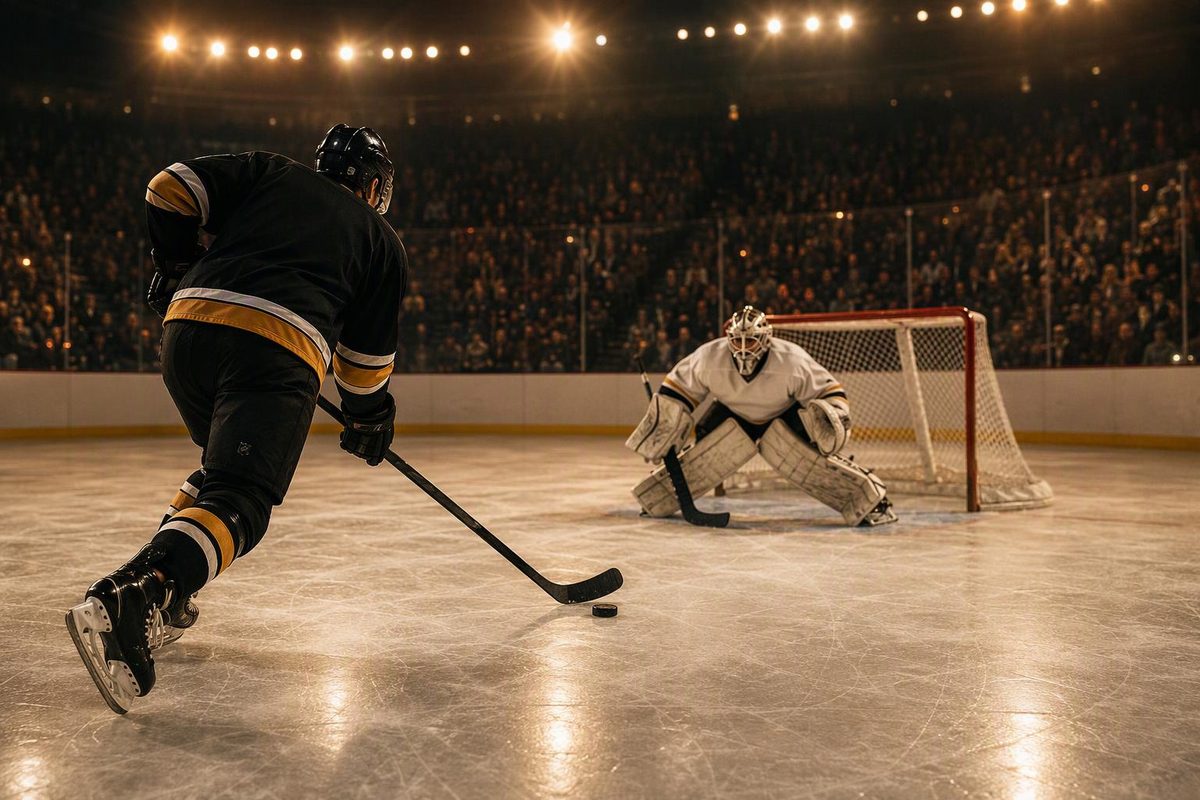
An ice hockey penalty shot gives one attacker an uncontested attempt to score against the opposing goalkeeper. It restores a scoring opportunity lost because of an infraction; it is not automatically awarded for every foul near the net.
The explanation below follows the NHL’s 2026–27 rulebook, Rule 24. Other competitions use their own rulebooks, so these details should not be assumed to apply unchanged to youth, recreational or international hockey.
When is a penalty shot awarded?
For the familiar case of an attacker fouled from behind on a breakaway, NHL Rule 24.8 lists four conditions, all of which must be met:
| Condition | What the referee must establish |
|---|---|
| Location | The infraction occurred in the neutral or attacking zone—beyond the attacker’s own blue line. |
| Direction | The infraction was committed from behind. |
| Lost scoring chance | The attacker had possession and control, or clearly would have obtained them, and was denied a reasonable chance to score. |
| Clear path | No opposing player was between the attacker and the goalkeeper. |
Getting a shot away does not automatically rule out a penalty shot. If the foul from behind deprived the attacker of a more reasonable scoring opportunity, a penalty shot can still be awarded. The referee is judging the chance lost, not simply whether the player managed to release the puck. Source: Rule 24.8.
Breakaway fouls are not the only route to a penalty shot. Other situations include:
- A defending skater illegally covering or gathering the puck in the crease. The puck’s location matters: being inside the crease while gathering a puck outside it does not, by itself, trigger a penalty shot.
- A defending team member throwing or shooting equipment at the puck or puck carrier in the defending zone. If the play finishes without a goal, a penalty shot is awarded.
- Deliberately displacing the defending team’s goal when the resulting minor cannot be served fully within regulation, or at any time in overtime.
Those situations have separate criteria under Rules 53.7 and 63.6. Some offenses instead produce an awarded goal: for example, a qualifying foul that prevents an unobstructed attacker from scoring after the defending team has removed its goalie for an extra attacker, under Rule 25.
How the attempt works
The referee places the puck on the center face-off spot. On the whistle, the shooter takes it toward the opposing goal; the other skaters withdraw to the sides of the rink in front of their own benches.
The important restrictions are:
- The puck must stay in motion toward the opposing goal line. A straight-line approach is not required, but the attempt ends if the puck comes to a complete stop or crosses the goal line.
- There is no rebound follow-up. The attacker cannot shoot again after a save. The rule permits the specific sequence of puck off a post or crossbar, then off the goalkeeper, and directly into the net.
- A 360-degree spin-o-rama is prohibited. Performing it ends the attempt with no goal.
- The goalkeeper must remain in the crease until the shooter touches the puck. After that, the goalie may come out to challenge.
These are the procedure requirements in Rule 24.2. If the goalie leaves the crease early and the shot fails, the shooter gets another attempt under Rule 24.4. The attempt does not consume regulation or overtime clock time, under Rule 24.7.
Who takes it?
When a specific player is fouled, that player normally takes the shot—not whichever teammate has the best shootout record. If injury prevents the designated player from taking it within a reasonable time, the captain selects a replacement from the players who were on the ice when the infraction occurred. For a crease-handling offense, the captain likewise selects from that on-ice group. Source: Rule 24.3.
What happens afterward?
If the shooter scores, the next face-off is at center ice. If not, it is normally at an end-zone face-off spot in the zone where the attempt occurred.
A failed penalty shot does not ordinarily create a power play for the same foul. If that offense would normally be a minor, the penalty shot replaces it regardless of the result. For a double-minor, the second minor is still served; additional penalties or more serious offenses can also require penalties to be served. A penalty-shot goal does not end a penalty already being served. Source: Rules 24.5–24.6.
Penalty shot versus shootout
A penalty shot responds to an infraction during the game. A shootout decides an NHL regular-season game still tied after five-minute overtime. Shootouts use Rule 24’s attempt mechanics, but coaches choose eligible shooters, with three attempts per team unless the result is settled earlier, followed by sudden-death rounds if needed. Stanley Cup playoff overtime has no shootouts. Source: Rules 84.4–84.5.
The distinction also matters statistically: a penalty-shot goal counts in the scorer’s goal total; a shootout goal does not. A penalty shot counts as a shot on goal if it scores or would have entered the net had the goalkeeper not stopped it. A miss does not. See how penalty shots count as shots on goal for the scoring breakdown. Sources: NHL statistical glossary and Rule 84.4.