
PIM in Hockey: Penalty Minutes Explained
PIM means penalty minutes, but it is not simply time spent shorthanded. See how minors, majors and misconducts enter an NHL stat line.
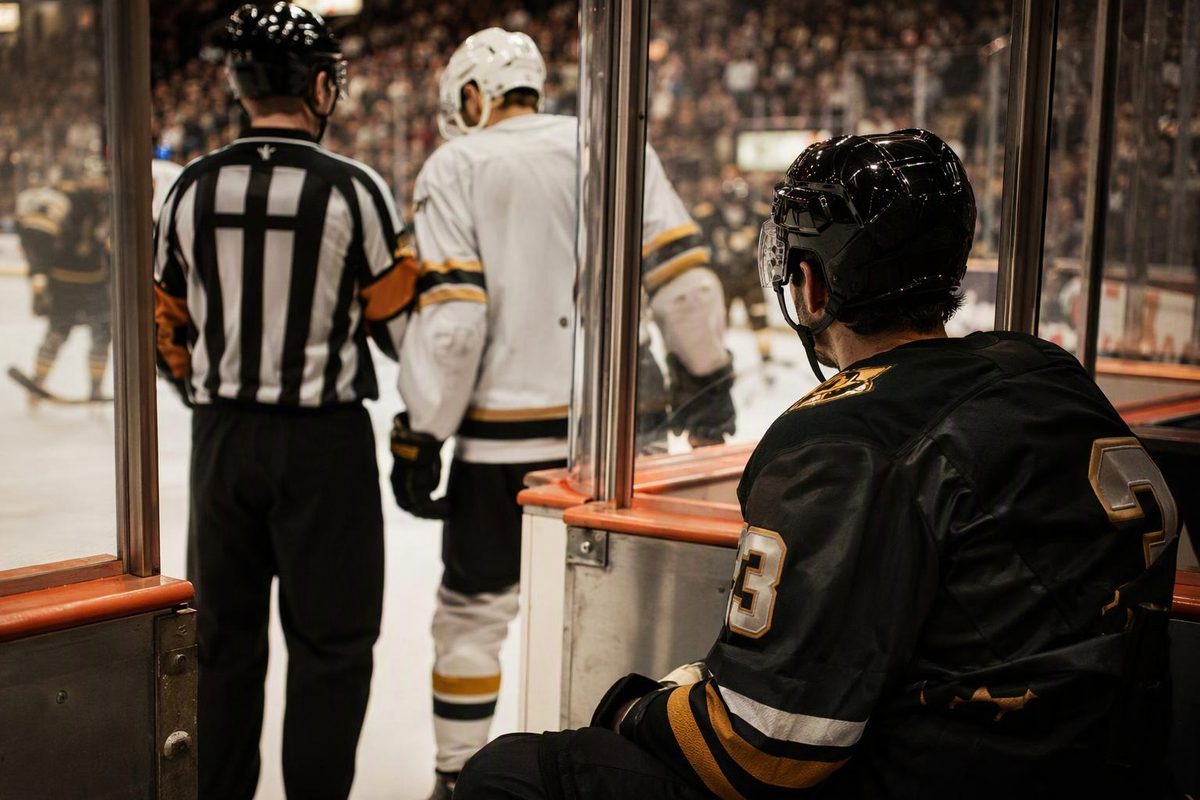
PIM means penalty minutes. In a hockey stat line, it is the sum of the minute values assigned to a player’s penalties—not a count of penalties and not necessarily the number of minutes the team played shorthanded.
The NHL statistics glossary defines PIM as all assessed penalty minutes, including penalties that did not produce an opposing power play. It lists Pen Taken separately as the number of penalties a player took (NHL Stats glossary).
How PIM is counted in the NHL
Under the NHL’s 2026-27 rules, the standard values are:
| Penalty type | PIM recorded | Usual manpower effect |
|---|---|---|
| Minor | 2 | Team normally loses one skater; the penalty may end after a power-play goal |
| Double-minor | 4 | Two consecutive two-minute minors; only two minutes are assessed if the opponent scores during the delayed call |
| Major | 5 | Team normally loses one skater for the full five minutes |
| Misconduct | 10 | Player is removed for 10 minutes, but a substitute may enter immediately |
| Game misconduct | 10 | Player is ejected; 10 minutes are entered in league records |
| Match penalty | 15 | Player is ejected; a substitute serves five minutes, with another 10 minutes added to the player’s record |
Rules 16–23 of the official 2026-27 NHL rulebook establish these values and their manpower effects. Other leagues and youth governing bodies may use different categories or durations, so PIM comparisons should stay within the same ruleset.
Why PIM does not equal actual penalty-box time
PIM is an accounting total. Several common situations separate it from elapsed time or team shorthanded time:
- A minor can end early. If the opposing team scores 18 seconds into an ordinary minor power play, the player still receives two PIM even though only 18 seconds elapsed.
- Coincidental penalties may create no power-play advantage. Two players can each receive five PIM for coincidental fighting majors while the teams continue at equal strength. The NHL glossary notes that fighting majors typically do not change manpower because they are usually assessed to both players (NHL Stats glossary).
- A misconduct adds PIM without reducing team strength. A player receiving a 10-minute misconduct can be replaced immediately. The player is unavailable, but the team is not automatically shorthanded.
- A game misconduct has a fixed statistical value. It adds 10 PIM whether the ejection occurs in the first period or with seconds remaining.
- The player serving a penalty may not be the player charged with it. For a bench minor, the coach designates a skater to serve the team penalty. A goaltender’s minor is also served by an eligible teammate. Merely serving either penalty does not add those minutes to the substitute’s personal PIM; Rules 17 and 27 explain these arrangements in the NHL rulebook.
Worked example
Suppose a player receives:
- one hooking minor: 2 PIM
- one fighting major: 5 PIM
- one misconduct: 10 PIM
The stat line shows 17 PIM. That does not establish that the player’s team was shorthanded for 17 minutes. The fighting major could have been coincidental, while the misconduct itself does not cause a manpower disadvantage.
PIM is not the number of penalties
A minor is one penalty worth two PIM, while a misconduct is one penalty worth 10 PIM. NHL record tables therefore report Pen and PIM in separate columns. For example, the league’s career table lists Dave Williams with 1,155 penalties and 3,971 PIM—not 2,310 PIM, as a simple two-minutes-per-penalty calculation would produce (NHL career PIM records).
How to interpret PIM as a performance stat
PIM answers a narrow question: How many penalty minutes were entered on the player’s record? It does not by itself measure discipline, toughness, defensive value or the cost of those penalties.
For a more useful comparison:
- Separate penalty types. A misconduct-heavy total means something different from repeated hooking and tripping minors.
- Identify non-coincidental penalties. These are more relevant when estimating how often a player put the team shorthanded.
- Normalize opportunity. PIM per game adjusts for different numbers of games played, while penalties taken per 60 minutes also accounts for ice time. Neither identifies the severity or game impact of the calls.
- Include penalties drawn. The NHL defines net penalties as penalties drawn minus penalties taken, adding context that PIM omits (NHL Stats glossary).
- Check the competition and season. Rule differences make PIM less portable across the NHL, international hockey, junior leagues and youth hockey.
Read PIM as an assigned penalty-minute value, not a stopwatch measurement of how long a player sat or how long a team killed penalties.