
How to Measure Hockey Stick Length: A Repeatable Method
Measure a hockey stick consistently, fit it with skates on, compare listed lengths correctly, and account for the flex change before cutting.
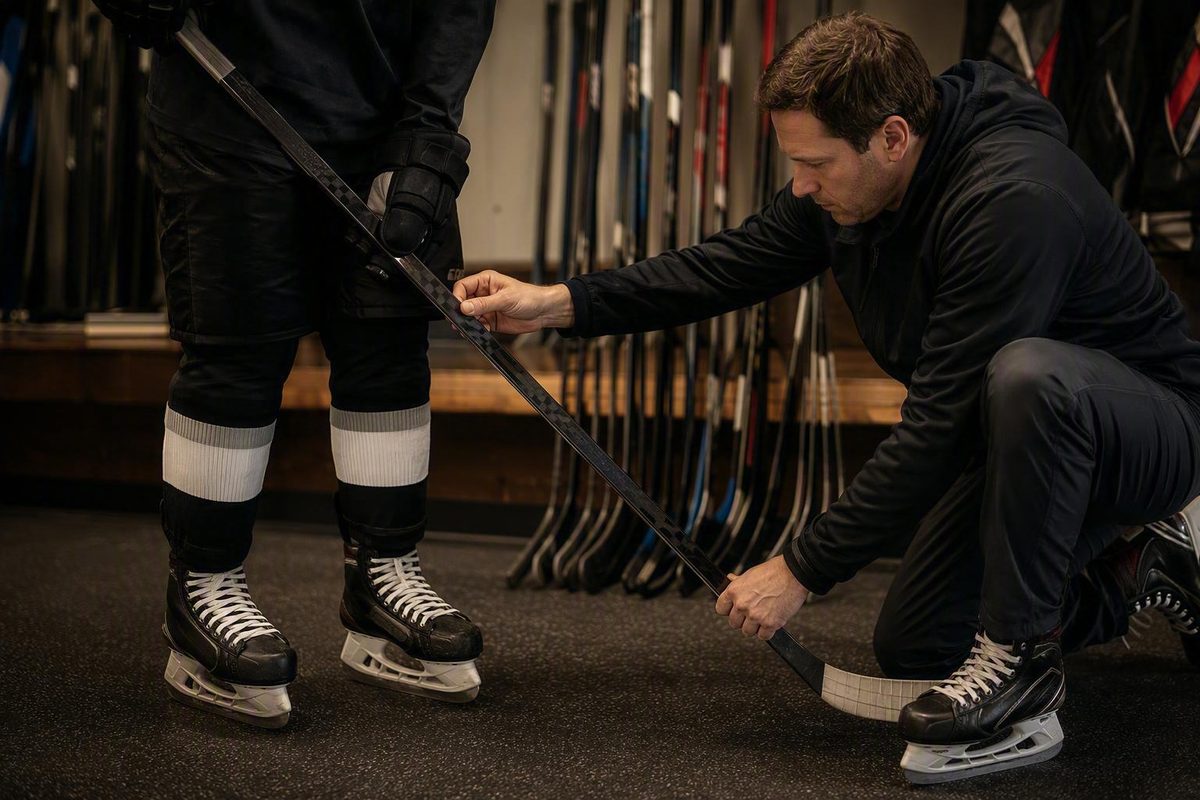
There are two different measurements people call “hockey stick length”:
- The stick’s physical length, used to compare one stick with another.
- The stick’s fit on a player, used to decide where to cut or extend it.
Do not substitute one for the other. A number such as 60 inches is useful only when you know where the measurement begins and ends, while a chin-or-nose check depends on whether the player is wearing skates.
Measure the stick itself
For a repeatable player-stick measurement:
- Remove any removable shaft extension if you want the original stick length; leave it installed if you want the current playing length.
- Stand the stick in its normal playing orientation on a hard, level floor.
- Put the bottom of the blade flat enough that its heel contact point meets the floor.
- Measure from that heel contact point to the top of the shaft, excluding any tape knob that projects above it.
- Record the result in inches or centimetres and state the method: for example, “60 in, heel contact point to shaft top.”
This heel-to-top convention matches the note accompanying a published Bauer size chart: stick length is measured “from the stick’s heel point of contact with the playing surface to the top of the shaft” (SCHEELS).
However, listed lengths are not automatically comparable across sellers. Some measure down the shaft to the heel, while others measure vertically from the shaft top to the floor with the stick standing on its toe (Pro Stock Hockey). Blade angle means those methods can produce different numbers for the same stick.
Practical rule: when comparing two sticks, measure both yourself with the same endpoints and blade position. Do not rely only on the printed or product-page length.
Fit the length to the player
Wear the skates used for play, stand upright, and place the stick’s blade toe on the floor between the feet with the shaft vertical. A useful starting range is between the chin and nose. Without skates, the common starting point moves to about nose height (SportsEngine/Pure Hockey).
That facial landmark is a starting measurement, not a precision fitting formula. It changes with posture, skate height and exactly how the blade is placed. For a more useful check:
- wear skates rather than trying to estimate their added height;
- stand naturally instead of bending into a skating stance;
- keep the shaft vertical for every comparison;
- mark the shaft at the desired finished height;
- test the stick in a normal hockey stance before cutting, if possible.
A player who lands near the chin end of the range has chosen a shorter setup than one near the nose end. The correct choice is the one that lets the player handle the puck and use the blade naturally; the face-height test does not by itself prove that a stick is optimal.
Worked example
Suppose a stick measures 60 inches from the heel contact point to the bare shaft top. With the player’s skates on, it reaches 2 inches above the preferred mark.
The planned finished length is:
60 in − 2 in = 58 in
Measure 2 inches down from the bare shaft top and mark that point squarely around the shaft. Recheck the fit before making the irreversible cut. If a taped knob extends above the shaft, do not use the top of that tape as the cutting reference.
Length changes flex, too
Cutting is not only a length adjustment. It makes the stick play stiffer; adding an extension has the opposite effect. Bauer explicitly says cutting raises the flex number and an extension lowers it (Bauer). CCM gives a useful estimate: about five additional flex units for every 5 cm cut, while also emphasizing that feel matters (CCM).
For the 2-inch cut in the example, 2 inches is about 5.1 cm, so CCM’s estimate implies roughly a five-unit increase in effective flex. Treat that as an estimate, not a universal conversion across every construction and brand.
This matters most when a player already struggles to bend the shaft. For a growing or lighter player, buying an excessively long, stiff stick and removing a large section can solve the height problem while creating a flex problem. Choose length and flex together, then make the smallest necessary cut.