
Hockey Stick Lie: Fit the Blade, Not Just the Number
Learn what hockey stick lie means, how higher and lower lies differ, and how stance, stick length and tape wear help you check blade contact.
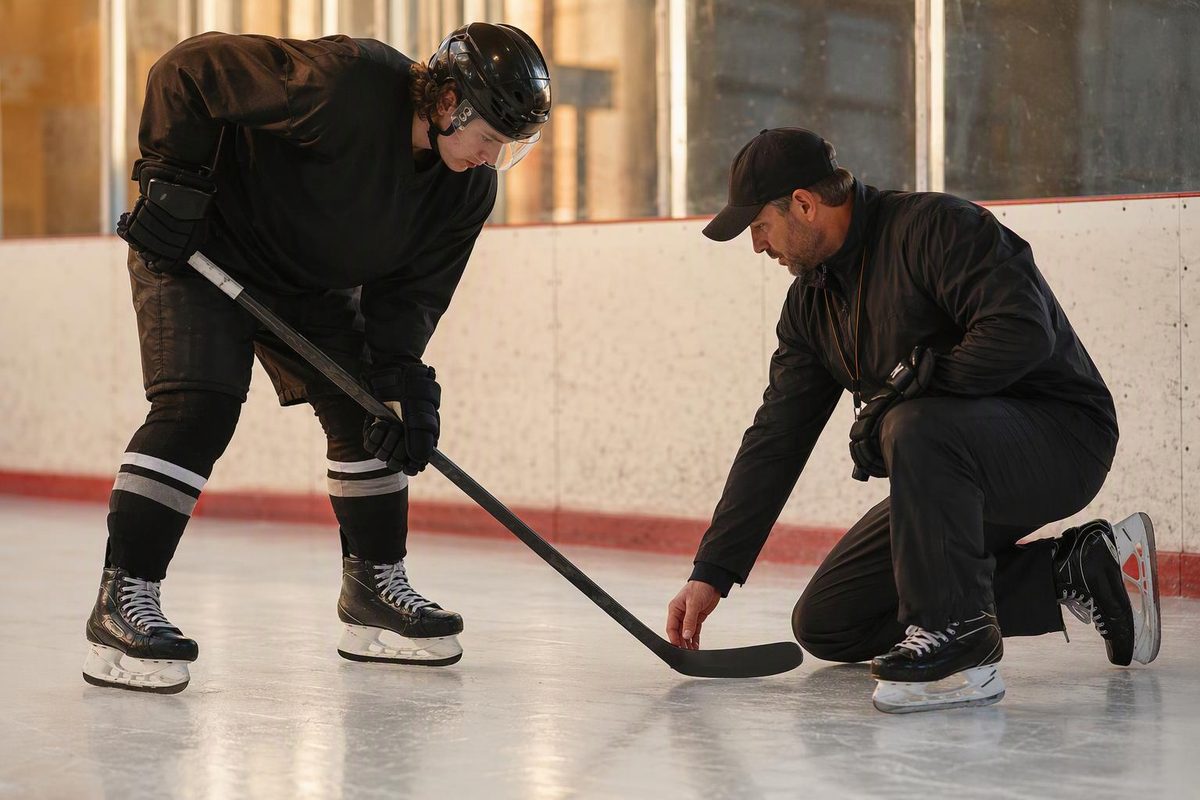
Hockey stick lie describes the angle between the shaft and blade. A higher lie number means a more upright shaft when the blade rests on the ice; a lower number means a flatter shaft angle. The useful question is whether that geometry matches your normal skating stance and hand position—not whether one number is better than another. Warrior defines lie as the blade–shaft angle; HockeyMonkey’s fitting guide explains the higher-versus-lower relationship.
This guide concerns player sticks, rather than goalie sticks.
What do lie 5 and lie 6 mean?
Lie is a numbered angle designation, not a measurement in degrees and not a stiffness rating. Flex describes how the shaft bends; lie describes its geometry relative to the blade.
With the blade resting in its intended contact position:
- Lower lie: the shaft sits flatter, generally accommodating a lower stance or a puck held farther from the body.
- Higher lie: the shaft sits more upright, generally accommodating a more upright stance or a puck held closer to the body.
Ice Hockey Systems’ coaching guidance uses lie 4 and lie 6 to illustrate those differences. They are fitting tendencies, not rules based on height or playing position. Your hands, posture and stick length all affect the angle at which you actually use the stick.
Be careful converting lie numbers to degrees
Published guides do not agree on a single conversion. Pro Stock Hockey describes lie 5 as a shaft angle of 45° above the ice, or 135° between blade and shaft. HockeyStickMan lists lie 5 at 43° above the ice. Both describe roughly 2° per lie-number step.
That disagreement matters when comparing charts: do not treat a lie label as a universally precise angle measurement. Check the specifications for the actual stick, then compare blade contact in the same stance. Also distinguish the acute shaft-to-ice angle from the larger blade-to-shaft angle; those are different ways of describing the geometry.
How to check your hockey stick lie
Try the stick with skates on, in a safe fitting area, using your normal knee bend and relaxed hand position. Put the blade where you usually control the puck—not wherever it happens to sit flat. Then inspect the bottom edge.
The heel is the end nearest the shaft; the toe is the far end.
| What you observe in your normal stance | Possible mismatch | Direction to test, with length and stance held constant |
|---|---|---|
| Heel contacts the surface while the toe is noticeably raised | Lie may be too high | Lower lie |
| Toe contacts the surface while the heel is noticeably raised | Lie may be too low | Higher lie |
| Useful contact around the middle, without a pronounced heel-only or toe-only tilt | No obvious mismatch | Confirm during puck handling and passing |
These directions match Pro Stock Hockey’s fitting instructions. Change one variable at a time; otherwise, you cannot tell whether a different lie or a different length improved the fit.
Tape wear offers a second clue. Hockey Skills Training recommends testing a lower lie for concentrated heel wear and a higher lie for concentrated toe wear. Treat wear as a prompt to check your setup, not an automatic diagnosis.
Why length and blade rocker matter
Cutting a shaft does not change the manufactured blade–shaft angle. It can change your hand position and where the blade sits relative to your body, changing how the blade contacts the ice. Extending the stick can do the same. Before making an irreversible cut, establish a consistent measurement using our hockey stick length guide.
There is another complication: the blade’s bottom edge need not be perfectly straight. Its curved heel-to-toe profile, called rocker, lets different portions contact the ice as the shaft angle changes. All Black Hockey Sticks explains this distinction.
So “flat on the ice” is fitting shorthand—not a demand that every millimetre of the blade touch at once. Look for useful contact in your usual puck-handling position, then check receiving passes and moving the puck closer and farther away. Choose the setup that works across those movements rather than forcing your posture to satisfy the printed lie number.