
The Biggest Hockey Scores Depend on Which Record You Mean
Compare South Korea’s 92–0 U18 win, Slovakia’s Guinness-listed 82–0 result, and the NHL records for team goals, combined scoring and winning margin.
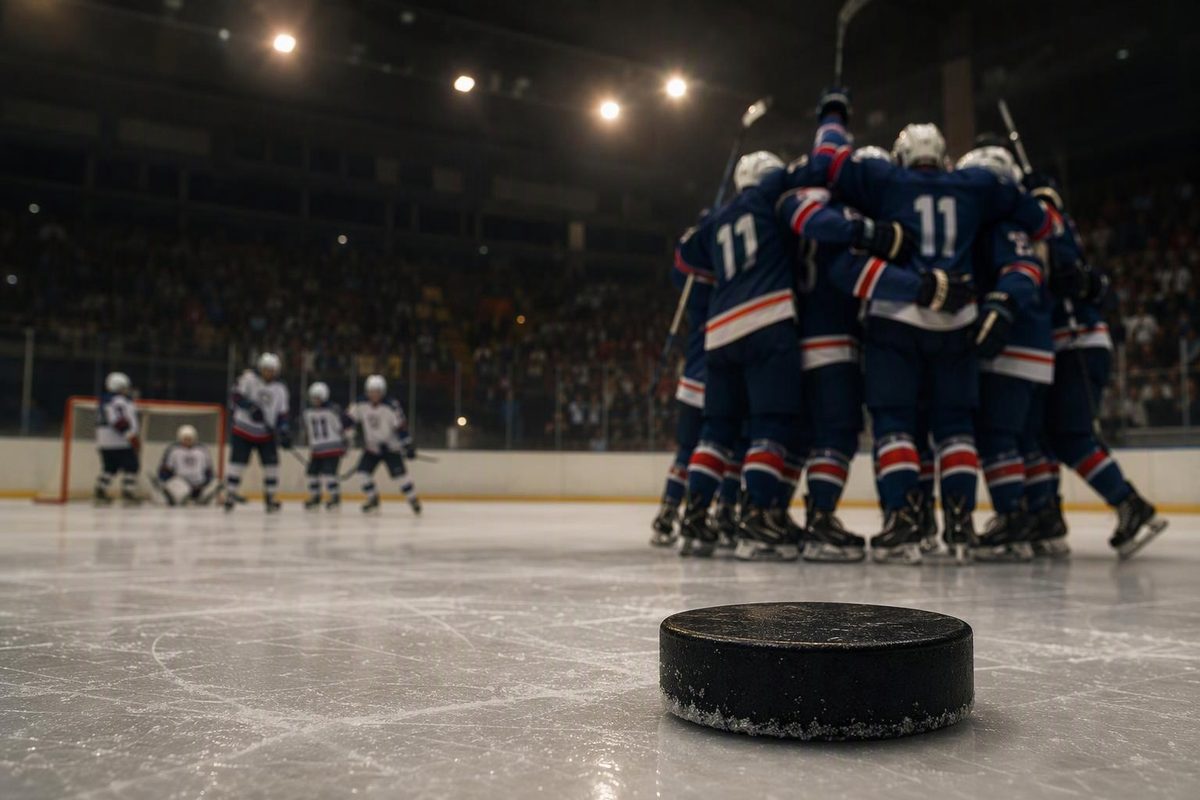
The larger documented international hockey score is South Korea’s 92–0 win over Thailand at the 1998 Asia-Oceania U18 Championship in Harbin, China, confirmed by the International Ice Hockey Federation. The often-quoted 82–0 was Slovakia’s senior women’s win over Bulgaria, listed by Guinness World Records. Neither is an NHL record. In the NHL regular season, the records are 16 goals by one team, 21 combined goals and a 15-goal winning margin.
Those answers measure different things. A youth international result does not establish a senior record, and a record for one team’s goals does not necessarily identify the game with the most total scoring. The tool separates the competition from the measurement rather than treating every large score as the same record.
Choose a competition and scoring measure to see the matching result.
Find the Matching Scoring Record
92 goals
South Korea 92–0 Thailand · 1998
Larger documented international result, in U18 competition. This is not a verified all-level record.
| Category | Score | Match |
|---|---|---|
| International U18 | 92–0 | South Korea–Thailand |
| Women’s qualifier | 82–0 | Slovakia–Bulgaria |
| NHL team goals | 16–3 | Montreal–Quebec |
| NHL margin | 15–0 | Detroit–NY Rangers |
| NHL combined | 14–7 | Montreal–Toronto |
| NHL combined | 12–9 | Edmonton–Chicago |
Sources: IIHF; Guinness World Records; NHL record tables and historical account, cited in the article. International rows describe documented results, not an unrestricted all-level ranking.
Why Both 92–0 and 82–0 Appear as Record Answers
The disagreement is not about which number is larger. South Korea’s 92 goals exceed Slovakia’s 82. The difficulty is that the two results appear in sources using different competition categories and record descriptions.
The IIHF documents South Korea’s 92–0 victory over Thailand in 1998 at the Asia-Oceania U18 Championship. That is an under-18 international result. It is evidence for a score larger than 82–0, but it should not be relabeled as a senior women’s result or an NHL result.
Guinness identifies Slovakia’s 82–0 victory on September 6, 2008, in Liepāja, Latvia, under the title “Highest score in an ice hockey match.” The game was a women’s pre-Olympic qualification match. It was not played at the Olympics themselves, a distinction that matters when describing an Olympic scoring record.
Guinness’s description calls 82–0 the highest score in an international ice hockey match. Its public entry does not explain how that wording fits with the larger U18 score documented by the IIHF. That gap should remain visible rather than being resolved by assuming an unstated eligibility rule.
ESPN’s contemporary report on Slovakia–Bulgaria explicitly mentions the earlier 92–0 game. It also reports that the IIHF called Slovakia’s result a record for a women’s IIHF-sanctioned event. That narrower description explains why 82–0 can be a record without being larger than the U18 result.
The defensible verdict is therefore category-specific: 92–0 is the larger documented international result; 82–0 is the senior women’s qualifier result listed by Guinness. The Guinness page alone does not establish that no larger score has occurred at any age level or in any hockey competition.
The Main Records Side by Side
These are the results behind the most common interpretations of “largest hockey score.” The NHL rows refer to regular-season records, not playoff records.
| Record Category | Result | When |
|---|---|---|
| International U18: larger documented result | South Korea 92–0 Thailand | 1998 |
| Guinness-listed senior women’s qualifier | Slovakia 82–0 Bulgaria | September 6, 2008 |
| NHL: most goals by one team | Montreal 16–3 Quebec | March 3, 1920 |
| NHL: largest winning margin | Detroit 15–0 New York Rangers | January 23, 1944 |
| NHL: most combined goals, tied | Montreal 14–7 Toronto; Edmonton 12–9 Chicago | January 10, 1920; December 11, 1985 |
The NHL’s one-team scoring record table lists Montreal’s 16-goal performance against the Quebec Bulldogs. Its combined-goal record table lists the two games tied at 21. Those figures remain consistent with the league’s tables as of October 7, 2026.
For Detroit’s margin record, the NHL’s account of the January 23 game confirms the 15–0 score and its record 15 consecutive goals. The zero on the losing side is what makes all 15 of Detroit’s goals count toward the winning margin.
The table is not a single ranking of equivalent competitions. It is a reference for choosing the correct answer: U18 international hockey, senior women’s qualification, or a particular NHL scoring measurement.
What the 92–0 Result Establishes
South Korea–Thailand is the larger of the two documented international results discussed here. Because Thailand scored no goals, South Korea’s team total, the combined game total and the winning margin are all 92.
That agreement makes the score easy to interpret mathematically. It does not remove the competition boundary. “South Korea won an international U18 game 92–0” is supported by the IIHF account; “92–0 is the senior international record” would attach the result to the wrong population.
The evidence supplied here also does not establish an unrestricted record covering every organized, amateur, exhibition or local hockey game. The precise wording is larger documented international result, not a claim that every possible game has been checked.
The cited material does not supply a shots-on-goal total or a period-by-period scoring breakdown for the 92–0 game. That means there is no supported shooting percentage or period comparison to place beside Slovakia’s detailed figures. A final score reveals how many goals were recorded; it does not reveal how many shots were needed to produce them.
This is why the result can settle the numerical comparison with 82–0 while leaving other performance questions unanswered. The score is documented, but the available tracking detail is not equivalent for the two games.
Slovakia’s 82–0 Has More Detailed Scoring Data
For Slovakia–Bulgaria, the sources provide both a period breakdown and a shots-on-goal total. Guinness records 31 goals in the first period, 24 in the second and 27 in the third. Those period totals add to the final 82.
| Period | Slovakia’s Goals |
|---|---|
| First | 31 |
| Second | 24 |
| Third | 27 |
| Total | 82 |
The first period supplied the largest portion of Slovakia’s scoring. The second had the fewest goals, but the scoring remained substantial in every period; the final result was not produced by just one unusually high-scoring stretch.
ESPN reports a 139–0 shots-on-goal advantage. It also reports that Janka Culikova scored 10 goals and that 14 Slovak players scored at least once. The team total was therefore spread across multiple scorers, rather than being the work of a single player.
The shots figure supports a conversion calculation for Slovakia. It does not supply Bulgaria’s total attempts, possession time or territorial distribution. “Zero shots on goal” should not be expanded into a claim that Bulgaria never attempted a shot or never had the puck; those are different measurements.
Likewise, the number of players who scored does not identify every player’s contribution. The supplied report gives Culikova’s goal total and the count of Slovak scorers, not a complete player-by-player scoring table. The available numbers are enough to describe the scale of the result without filling those gaps.
The 82–0 Scoring Rate Is an Average, Not a Timeline
Using Slovakia’s reported totals over a 60-minute game produces three useful descriptions of the same performance.
| Measurement | Calculation | Result |
|---|---|---|
| Shooting percentage | 82 ÷ 139 × 100 | 59.0% |
| Goals per minute | 82 ÷ 60 | 1.37 |
| Game-clock seconds per goal | 3,600 ÷ 82 | ~43.9 |
The shooting percentage is rounded to one decimal place. It describes the share of Slovakia’s recorded shots on goal that became goals, not the share of all shot attempts. Using a different denominator would answer a different question.
The rate of 1.37 goals per minute uses game-clock time. It is not a rate per minute of elapsed viewing time, which would include stoppages and breaks. The same distinction applies to the average of approximately 43.9 seconds of game time per goal.
That average does not mean a goal arrived at regular intervals. Without goal timestamps, the spacing between individual goals is unknown. The period totals already show that the scoring was not distributed equally across the three periods.
These figures describe an extreme mismatch. They are not useful targets for a player’s shooting percentage or a team’s normal scoring rate. Their value here is explanatory: they translate the final score into shot conversion and scoring frequency using the reported denominators.
Montreal’s 16–3 Is the NHL One-Team Scoring Record
The Montreal Canadiens’ 16–3 win over the Quebec Bulldogs on March 3, 1920, is the NHL regular-season record for goals scored by one team in one game. The record value is Montreal’s 16, not the sum of both sides.
That score produces three different measurements: 16 goals by the winner, 19 combined goals and a 13-goal winning margin. All three are correct descriptions of the game, but only the first is the NHL record represented by this result.
Quebec’s three goals increase the combined total while reducing Montreal’s margin. This is the central reason that a high-scoring game and a large victory are not interchangeable. Opponent scoring moves those two measurements in opposite directions.
Calling Montreal–Quebec the NHL’s “highest-scoring game” without specifying one-team goals would therefore be misleading. The game has the largest individual team total in the regular-season record table, but its combined total is below the tied 21-goal record.
Detroit’s 15–0 Is the NHL Winning-Margin Record
The Detroit Red Wings’ 15–0 win over the New York Rangers on January 23, 1944, answers a different question: the largest NHL regular-season winning margin.
Detroit scored fewer goals than Montreal did in the 16–3 game, yet won by more. With no Rangers goals to subtract, Detroit’s margin is 15 goals, compared with Montreal’s 13-goal margin against Quebec.
The shutout also makes Detroit’s one-team total, combined total and margin identical within that game. Each is 15. That does not make Detroit the holder of all three NHL records; it only means the three calculations happen to return the same number for this score.
The NHL’s account also describes Detroit’s record 15 consecutive goals. That is a scoring-sequence distinction, separate from the combined-goal record. It should not be used to imply that the game contained more total scoring than the 21-goal games.
Two NHL Games Share the 21-Goal Combined Record
For the most goals in an NHL regular-season game, count both teams. Montreal’s 14–7 win over the Toronto St. Patricks on January 10, 1920, and Edmonton’s 12–9 win over Chicago on December 11, 1985, both total 21 goals.
The calculations are 14 + 7 = 21 and 12 + 9 = 21. Neither winning team reached Montreal’s one-team record of 16 goals, and neither score produced Detroit’s 15-goal margin. Their record comes from the contribution of both sides.
A combined-goal record is therefore a measure of game-wide scoring, not dominance. A close game can generate a large combined total when both teams score heavily; a shutout can generate a large margin without setting the combined record.
Our guide to the highest-scoring NHL game covers those tied results and the playoff distinctions. Keeping regular-season and playoff records separate avoids assigning a record from one competition phase to another.
Use the Measurement That Matches the Question
For the larger documented international score, use South Korea 92–0 Thailand, with the U18 category attached. For the Guinness-listed senior women’s qualification result, use Slovakia 82–0 Bulgaria, without calling it an Olympic Games score.
For NHL regular-season questions, the wording decides the answer. “Most goals by one team” points to Montreal’s 16–3 win. “Biggest win” points to Detroit’s 15–0. “Most goals in a game” points to the two games tied at 21 combined goals.
Team goals are one side’s total; combined goals are both totals added together; winning margin is the winner’s total minus the loser’s total. Attaching that measurement and the competition category to the score gives a precise answer without overstating what the sources establish.