
Two NHL Games Share the 21-Goal Record
Two games share the NHL record at 21 combined goals. Compare the 1920 and 1985 scores with the one-team and Stanley Cup playoff records.
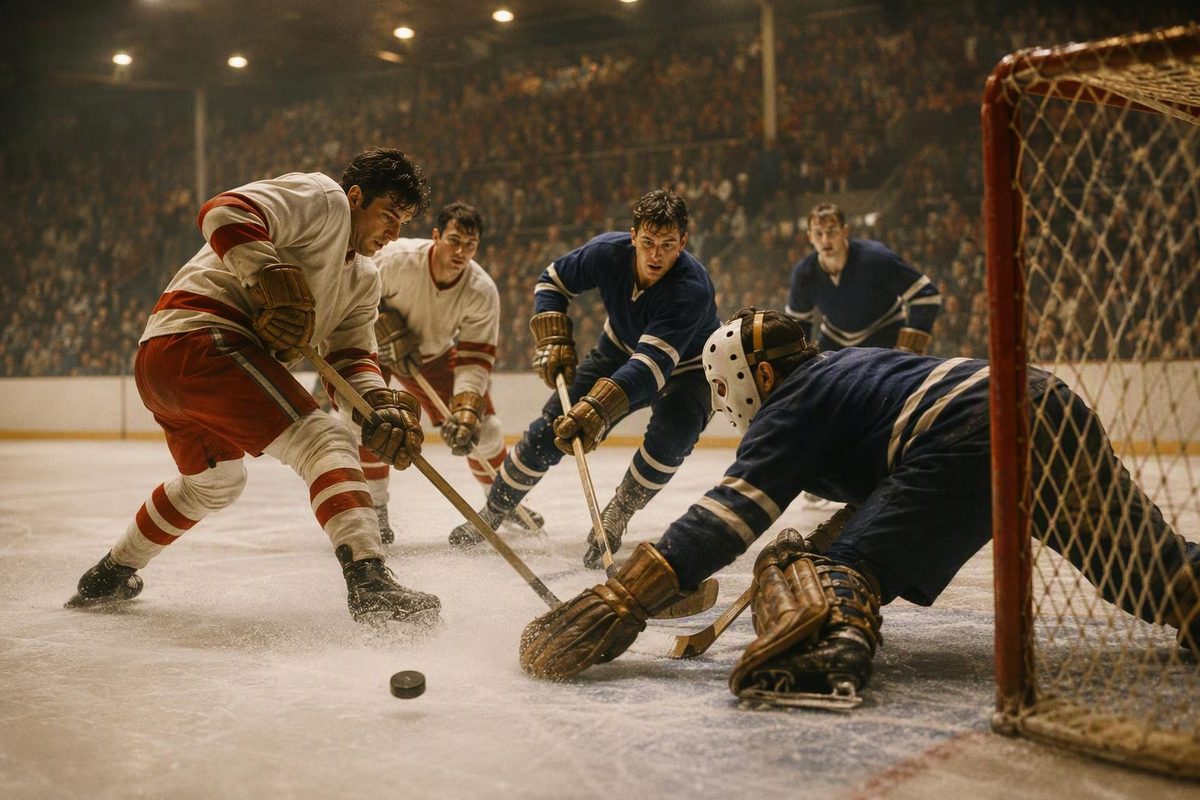
The highest-scoring NHL game produced 21 combined goals, a record shared by two regular-season games: the Montreal Canadiens’ 14-7 win over the Toronto St. Patricks on January 10, 1920, and the Edmonton Oilers’ 12-9 win over the Chicago Blackhawks on December 11, 1985. The NHL’s official table ranks the 1920 game first and the 1985 game second, but both finished with 21 goals and share the numerical record for most goals by both teams in one game (NHL Records).
Enter a final score and choose the game type to compare it with the NHL records.
Compare A Score With The NHL Record
Score Result
This ties the 21-goal regular-season and overall NHL record.
Team A’s 14 goals are two below the 16-goal regular-season record for one team.
| Category | Record | Example |
|---|---|---|
| Regular-season combined | 21 | 14-7 or 12-9 |
| Playoff combined | 18 | 10-8 |
| One team, regular season | 16 | 16-3 |
Source: NHL regular-season records and NHL playoff records.
The Two 21-Goal Games Compared
| Date | Final score | Goals by period | Total |
|---|---|---|---|
| Jan. 10, 1920 | Montreal 14, Toronto 7 | 8, 7, 6 | 21 |
| Dec. 11, 1985 | Edmonton 12, Chicago 9 | 4, 12, 5 | 21 |
Both games completed all of their scoring within the standard three regulation periods. Across 60 minutes of playing time, 21 goals works out to one goal per 2 minutes 51 seconds on average.
That figure describes scoring density across the whole game. It does not mean the goals arrived at regular intervals. The period totals show that the two record games followed substantially different paths.
The 1920 game began with eight combined goals in the first period, followed by seven in the second and six in the third. Its scoring declined by one goal from period to period, even though every period remained productive.
The 1985 game opened with four combined goals, surged to 12 in the second period and ended with five in the third. More than half of its 21 goals were concentrated in one period. That middle-period burst was the defining segment of the game and tied an NHL record for goals in a period.
The final totals were identical, but the margins were not. Montreal won its game by seven goals, 14-7. Edmonton won by three, 12-9. The 1985 matchup therefore combined the same record total with a closer final score and a much sharper in-game scoring spike.
Montreal Built Its 1920 Lead Immediately
Montreal led the Toronto St. Patricks 7-1 after the first period. Those eight combined goals already represented more than one-third of the game’s eventual total, and Montreal had established a six-goal advantage before the second period began.
The Canadiens led 11-4 after two periods. Toronto matched Montreal’s three third-period goals, producing the final 14-7 score, but that even final period did not reduce the seven-goal margin carried into it.
Newsy Lalonde scored six times for Montreal. Didier Pitre and Odie Cleghorn each recorded a hat trick. Together, those three players accounted for 12 of Montreal’s 14 goals.
The official NHL game sheet lists the scoring sequence and Montreal’s period totals of seven, four and three. Toronto scored once in the first period and three times in each of the next two, producing the combined period totals of eight, seven and six shown above.
The game also illustrates why the combined-goals record and the one-team record must be treated separately. Montreal’s 14 goals were an enormous portion of the 21-goal total, but 14 is not the NHL record for goals by one team. Montreal established that different record later in 1920 by scoring 16 against the Quebec Bulldogs.
Edmonton And Chicago Produced A 12-Goal Period
Edmonton led Chicago 4-0 after the first period in 1985 and extended the advantage to 6-0 before Chicago’s comeback began. The Blackhawks did not erase the deficit, but their response changed the game from an early rout into a 21-goal record performance.
The teams scored six goals apiece in the second period. That made it a 12-goal period, tying an NHL record according to the league’s historical account of the game.
Because Edmonton and Chicago matched each other during that period, the Oilers retained the four-goal lead they had held after the first. The scoring was unusually concentrated without producing a change in the underlying margin at the second intermission.
Chicago closed to 7-5 and later 8-6. Each score brought the Blackhawks within two, but Edmonton held on for a 12-9 victory. The nine goals scored by the losing team are central to why this game reached 21 despite Edmonton scoring two fewer than Montreal had in the other record game.
Jari Kurri recorded a hat trick for Edmonton. Wayne Gretzky had seven assists without scoring a goal. Those performances also show that an extreme team scoring total can be distributed in different ways: one player supplied three goals, while another contributed to seven goals through assists alone.
The official box score records 44 Edmonton shots on goal and 46 for Chicago. The teams therefore combined for 90 shots on goal.
Dividing 21 goals by those 90 shots gives a simple goals-per-shot-on-goal rate of 23.3%. Put another way, the calculation is 21 divided by 90, multiplied by 100. It measures how many recorded shots on goal became goals across that game; it is not an individual shooting percentage or a measure of every shot attempt.
The 1920 And 1985 Shot Rates Cannot Be Compared
The same shot-based calculation cannot be extended responsibly to the 1920 game. Its NHL game sheet contains the scoring sequence but no usable shot totals.
The missing denominator matters. The two games can be compared directly by final score, combined goals, winning margin and period scoring because those figures are available for both. A goals-per-shot-on-goal comparison requires shot totals from both games.
Assigning the 1985 game’s 90-shot volume to the 1920 game, or estimating an undocumented total, would create a comparison unsupported by the cited records. The correct shot figure for the 1920 matchup is therefore unknown here rather than zero or an estimate.
The shared 21-goal record establishes only that the final combined output was the same. It does not establish that the teams generated similar shot volume, similar chance quality or similar goaltending conditions. The 23.3% calculation belongs specifically to the Edmonton-Chicago game and the shot totals in its official box score.
The One-Team Record Is 16 Goals
“Highest-scoring game” usually refers to the sum of both teams’ scores. Under that definition, the answer is 21. If the question instead asks for the most goals scored by one NHL team in a game, the regular-season record is 16.
Montreal defeated the Quebec Bulldogs 16-3 on March 3, 1920, according to the NHL’s one-team goals record. The Canadiens’ 16 goals exceed their 14 against Toronto in the shared combined-goals record game.
The Quebec game finished with 19 combined goals. It therefore holds the one-team mark cited here but falls two goals short of the 21-goal combined record.
This distinction prevents two different questions from being collapsed into one ranking. A game can contain a record performance by one team without becoming the highest-scoring game overall. The opponent’s contribution determines the combined total: Quebec scored three in the 16-3 game, while Toronto scored seven in the 14-7 game.
The three relevant regular-season scores can be separated cleanly:
- Montreal 14, Toronto St. Patricks 7: 21 combined goals, tying the overall game record.
- Edmonton 12, Chicago 9: 21 combined goals, tying the overall game record.
- Montreal 16, Quebec Bulldogs 3: 16 by one team, but 19 combined.
A score comparison should therefore begin by specifying whether “highest scoring” means both teams added together or the output of one team.
The NHL Playoff Record Is 18 Combined Goals
The postseason record is 18 combined goals, three below the regular-season and overall mark. The Los Angeles Kings beat the Edmonton Oilers 10-8 on April 7, 1982, in Game 1 of their division semifinal.
The NHL playoff record book lists that game ahead of Pittsburgh’s 10-7 win over Philadelphia in 1989. The Pittsburgh-Philadelphia game produced 17 combined goals, one fewer than Los Angeles-Edmonton.
Fifteen players scored in the 1982 game. Charlie Simmer broke an 8-8 tie with 5:04 remaining, according to the NHL’s account of the record. Los Angeles added another goal to finish with the 10-8 score.
The playoff classification changes the relevant benchmark. A hypothetical 18-goal regular-season score would fall short of the 21-goal overall record, while an 18-goal playoff score would tie the postseason record. That is why the calculator asks for game type rather than comparing every score with one threshold.
The Record Depends On The Category
The principal NHL scoring records addressed by “highest-scoring game” are:
| Category | Record | Record game |
|---|---|---|
| Combined, regular season | 21 | Montreal-Toronto; Edmonton-Chicago |
| Combined, playoffs | 18 | Los Angeles 10, Edmonton 8 |
| One team, regular season | 16 | Montreal 16, Quebec 3 |
The broad answer remains 21 combined goals because that is higher than the cited playoff total and represents the most goals scored by both teams in an NHL game. It was reached once with a 14-7 score and once with a 12-9 score.
The score alone answers the record question, while the period and shot data explain how the two games differed. Montreal controlled its 1920 game from a 7-1 first period onward. Edmonton and Chicago reached the same total through a 12-goal second period, 90 combined shots on goal and a Chicago comeback that repeatedly narrowed the lead without overturning it.