
Why NHL Teams Carry More Players Than They Dress
Separate the NHL’s 23-player active-roster limit from its 20-player game lineup, including healthy scratches, injured reserve and playoff roster rules.
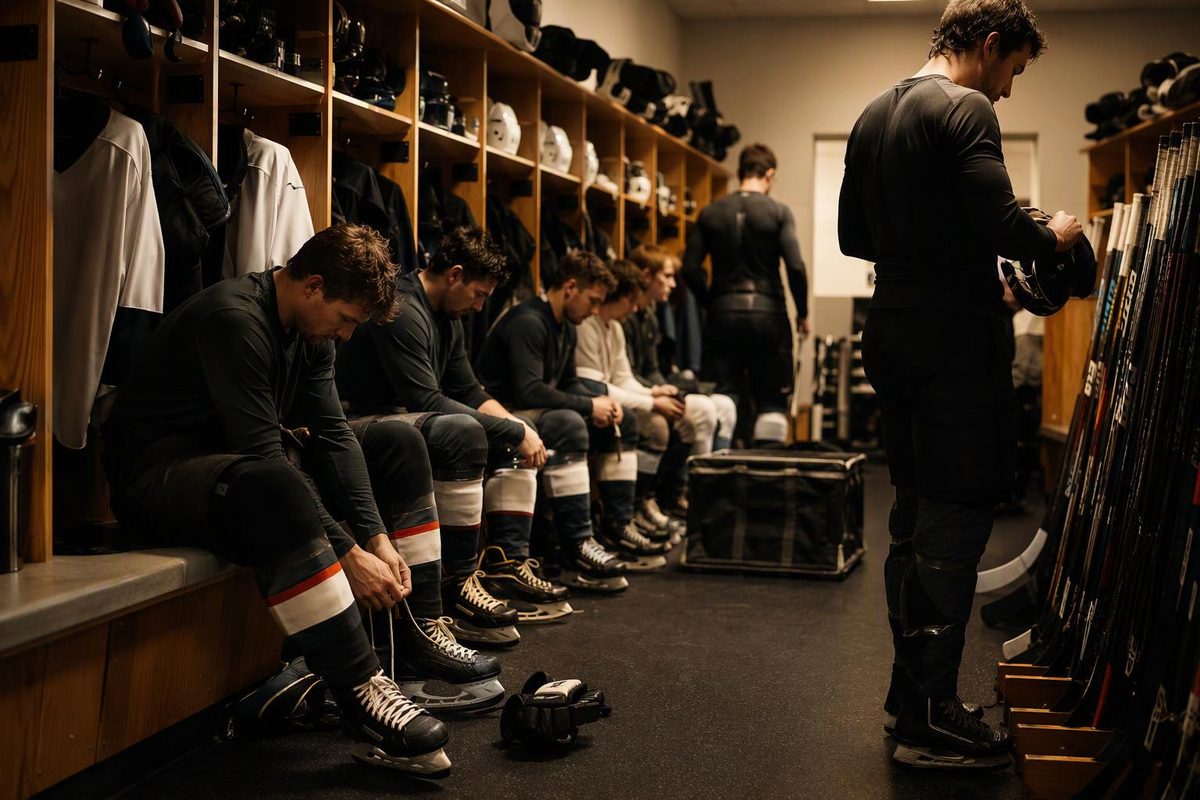
An NHL team normally carries 20–23 players on its active roster before the trade deadline, but dresses 20 for a game: 18 skaters and two goalies. The 23-player maximum applies from the start of the regular season and lifts on the trade-deadline date. Players on injured reserve do not count toward that active-roster limit. (NHL roster guidelines; CBA, Section 16.4(a))
The distinction is between the active roster, which identifies the players a club carries, and the game lineup, which identifies those selected to dress that night. A player can belong to the active roster without appearing in the lineup. That is why both “23 players” and “20 players” can be correct answers, depending on what you are counting.
Choose the season stage and the count you need; the result distinguishes roster space from game-lineup limits.
NHL Roster Count Selector
Pre-deadline active roster
23 is the ceiling, not a required total. Injured-reserve players do not count toward it; injury and emergency exceptions apply to the normal minimum.
Count Definitions and Exceptions
Before the deadline: Normally 20–23 active players. Injured reserve is outside this count.
Deadline date onward: The 23-player ceiling lifts. Salary-cap and recall rules still apply; there is no single fixed active total supplied here.
Full game lineup: 20 players: 18 skaters and two goalies. The substitute goalie must be equipped and ready.
2026–27 playoffs: The lineup remains 20, with a playoff playing-roster salary-cap calculation. A larger available pool does not enlarge the lineup.
Sources: NHL roster guidelines; CBA Sections 16.4 and 16.11; 2026–27 Rules 5.1–5.3; 2025 NHL–NHLPA agreement, Attachment 25-B. Positional splits beyond skaters and goalies are not prescribed here.
The Standard Counts Are 23 Active and 20 Dressed
| What You Are Counting | Players | What Is Included |
|---|---|---|
| Active roster before the deadline | Normally 20–23 | Dressed players and active players sitting out |
| Full game lineup | 20 | 18 skaters and two goalies |
| Skaters in the lineup | 18 | Forwards and defensemen combined |
| Goalies in the lineup | 2 | Starter and equipped backup |
The game-lineup figures come from Rule 5.1 of the 2026–27 NHL rulebook. Rule 5.3 requires the substitute goalie to be fully equipped and ready to play. The backup therefore occupies a lineup spot even when the starter plays the entire game. (NHL official rules, Rules 5.1–5.3)
“Twenty-three” is a roster ceiling, not a requirement to employ that exact number of active players every night. A team carrying fewer than 23 can still submit a full game lineup. Conversely, carrying the maximum does not allow the coach to dress everyone.
The normal active-roster minimum is 18 skaters and two goalies, although the collective bargaining agreement includes injury and emergency exceptions. That qualification matters: the normal 20–23 range describes ordinary roster operation, not every exceptional situation a club could encounter. (CBA, Section 16.4)
The count also does not describe how many players are skating at once. A game lineup includes players waiting on the bench and the backup goalie. It is a list of participants available for that game, not a snapshot of the ice during a shift.
A Full Active Roster Leaves Three Players Outside the Lineup
With 23 active players and a full 20-player lineup, three active players are left out. A healthy player omitted from the lineup is a healthy scratch. Being scratched does not, by itself, remove that player from the active roster.
The subtraction is straightforward: 23 active players minus 20 dressed players equals three active players outside that night’s lineup. This is the source of the apparent mismatch between a team’s roster page and its game lineup.
Those three should not automatically be described as healthy scratches without knowing their status. “Healthy scratch” specifically describes a healthy player who is not selected. The count alone tells you how many active players are outside the lineup; it does not tell you why each player is absent.
For a team carrying fewer players, the difference is smaller. At the normal minimum of 20 active players, a full 20-player lineup uses the whole active roster. The number sitting out follows from the actual active count, not from the maximum the club is permitted to carry.
This distinction is useful when checking whether a player is available. An active-roster listing establishes that the player belongs to that roster. It does not establish that the player will dress, start, or receive ice time in a particular game. The submitted game lineup is the relevant list for participation that night.
The Rules Require 18 Skaters, Not a Fixed Positional Split
An illustrative 23-player roster could contain 14 forwards, seven defensemen and two goalies. If the coach selects 12 forwards, six defensemen and two goalies for a game, two forwards and one defenseman sit out.
| Position | Active Roster | Game Lineup | Left Out |
|---|---|---|---|
| Forwards | 14 | 12 | 2 |
| Defensemen | 7 | 6 | 1 |
| Goalies | 2 | 2 | 0 |
| Total | 23 | 20 | 3 |
These are illustrative counts, not a mandated roster construction. The rule specifies 18 skaters rather than a compulsory split between forwards and defensemen. The example shows one way to reach the limit; it does not establish that every NHL club carries those positions in those quantities.
That distinction also prevents a common counting error. The two goalies are included in the 20-player lineup, but they are not included in its 18-skater total. Adding 18 skaters and two goalies gives the full lineup. Adding two goalies to a figure already described as 20 dressed players would count them twice.
Only players on the submitted game lineup may participate, subject to the rulebook’s emergency-goalie provision. Having another skater on the active roster does not make that player an interchangeable extra participant once the game lineup has been submitted. The ordinary roster pool and the authorized game participants serve different purposes under Rules 5.1–5.3.
Injured Reserve Opens a Roster Slot, Not Automatic Cap Room
A player on injured reserve does not occupy one of the 23 active-roster slots. A club can therefore replace that player on the active roster without the injured player counting against the active-player ceiling.
However, regular injured reserve does not, by itself, remove the player’s salary-cap charge. A roster opening and available cap space are separate questions. A team can have room under the player-count limit without having enough cap room for the replacement it wants. (CBA, Section 16.11(d))
This is also why a broad team roster listing can appear to contain more names than the active limit allows. If the list includes injured-reserve players, it is not necessarily a list of players who all count toward the active-roster ceiling. Before comparing a displayed total with 23, check what categories the list includes.
Do not subtract every injured player automatically. The relevant distinction in this rule is whether a player has been placed on injured reserve, not simply whether the player is described as hurt or misses a game. An injury report and an active-roster count are not interchangeable records.
The supplied sources do not provide a single replacement-cost figure or a universal amount of cap relief. None is needed to answer the roster-size question. The supported conclusion is narrower: injured reserve can free an active-roster slot, while ordinary injured reserve alone does not erase the salary-cap charge.
The 23-Player Ceiling Lifts on the Trade-Deadline Date
The active-roster maximum does not remain in effect until the regular season ends. Under Section 16.4(a), the 23-player ceiling lifts on the trade-deadline date. After that point, a club may expand its active roster, subject to salary-cap and recall rules. (CBA, Section 16.4(a))
The change applies to the roster pool, not to the number dressed for a game. A larger active roster still supplies a 20-player lineup. Extra available players provide additional selection options; they do not create additional places in the game lineup.
“No 23-player ceiling” should not be read as “no restrictions.” The supplied rule establishes when that particular numerical ceiling ends. It does not eliminate the other rules governing whether a player can be recalled or accommodated under the salary cap.
There is therefore no single fixed post-deadline active-roster count to substitute for 23. The actual number depends on the club’s roster decisions within the applicable rules. Reporting a specific larger number as the universal NHL roster size would confuse a team’s chosen count with a league-wide requirement.
When reading a roster figure, establish whether it refers to the period before the deadline or the period beginning on the deadline date. The same count can have a different meaning on either side of that boundary, even though the full game-lineup count stays the same.
Playoff Teams Still Dress 20 Players
For the 2026–27 playoffs, the game lineup remains 18 skaters and two goalies. A larger pool of available players does not enlarge the dressed lineup.
The rules applicable in 2026–27 also include a playoff playing-roster salary-cap calculation. This requirement was implemented ahead of the new CBA’s September 2026 effective date. Playoff lineup selection therefore cannot be described simply as an unrestricted choice from everyone available. (NHL explanation of playoff cap implementation; 2025 NHL–NHLPA agreement, Attachment 25-B)
Two different limits are involved here. The pre-deadline active-roster ceiling governs the size of the active pool during that part of the regular season. The playoff playing-roster cap concerns the applicable salary-cap calculation for the selected playoff roster. Neither changes the full lineup’s 20-player count.
The supplied material does not establish one standard total for every club’s entire playoff player pool. The precise answer supported here is that each full playoff game lineup has 20 players, while a club can have more players available outside that lineup.
For a playoff roster page, count categories before counting names. A list of available players is not necessarily the dressed lineup, and a list that includes injured players is not necessarily an active-only list. Use the game lineup when the question is who can participate that night.
Match the Number to the List You Are Reading
For the ordinary pre-deadline active NHL roster, the answer is normally 20–23 players. For a full game lineup, it is 20: 18 skaters and two goalies. For active players omitted from a game, subtract the full lineup from the actual active-roster count rather than assuming every team carries 23.
For a roster that includes injured-reserve players, a raw name count does not establish compliance with the active limit. For a post-deadline or playoff player pool, 23 is no longer the applicable active-roster ceiling, but the lineup remains 20 and other restrictions still apply.
The decisive detail is the label attached to the number. “Active,” “dressed,” “skaters,” and “available” describe different groups. Keeping those groups separate resolves the roster-size question without treating a team’s entire player list as its lineup.